Platform Economies in the Global South: Gig Work, Digital Markets, and Development
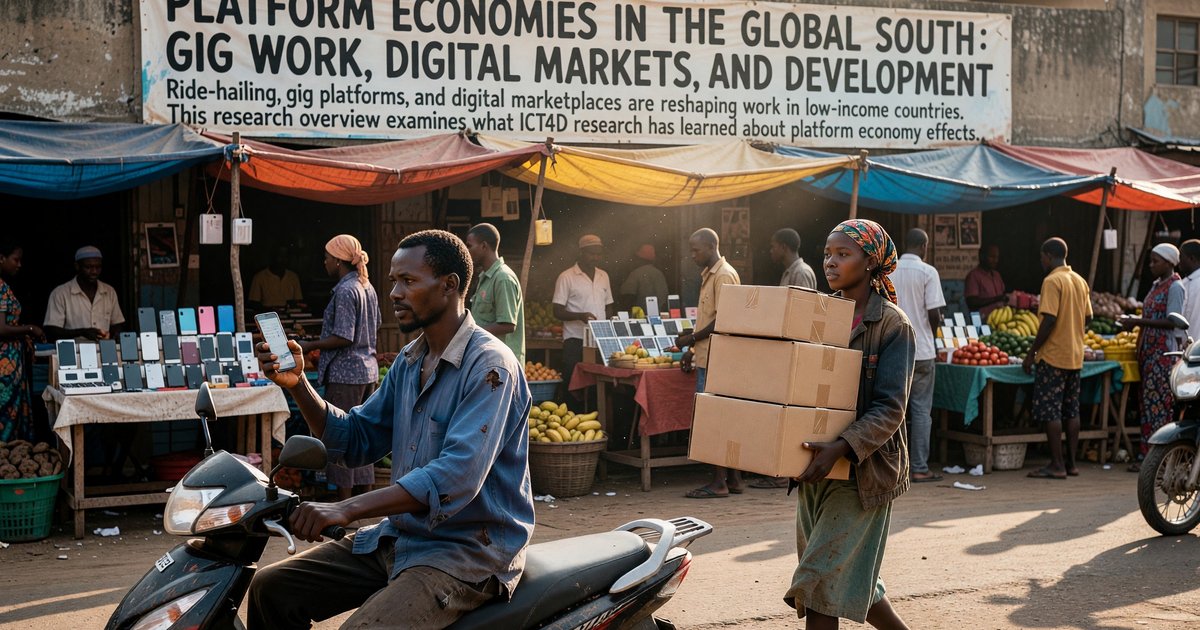
The platform economy — digital platforms that facilitate transactions between producers and consumers, often using algorithmic matching and rating systems — arrived in major cities of the Global South faster than many observers expected. Uber launched in Nairobi in 2015; by 2020, ride-hailing had transformed urban transportation and labor markets across sub-Saharan Africa. Similar dynamics played out across South and Southeast Asia, Latin America, and the Pacific.
ICT4D researchers were initially slow to engage with platform economy dynamics — the field’s attention had been on the rural and peri-urban populations most excluded from digital economies, not on urban workers increasingly embedded in platform labor markets. But by the early 2020s, a growing body of ICT4D and development economics research was examining how platform economies interact with development outcomes in low-income country contexts.
This overview surveys what the research has found.
Platform Economy Landscape in Low-Income Countries
Ride-hailing: Uber, Bolt, and local competitors (Little, Taxify) operate in major African cities. Research on ride-hailing in Nairobi, Lagos, Cape Town, Accra, and other cities documents rapid adoption and fundamental changes to taxi and transportation markets. Platform drivers earn more than traditional taxi drivers in some studies; less in others, after accounting for vehicle depreciation and fuel costs.
Delivery platforms: Food delivery (Jumia Food, Bolt Food, Glovo) and courier services have expanded in African urban areas, particularly during COVID-19, which accelerated demand for delivery services. Delivery workers are typically in highly precarious conditions — no benefits, income dependent on order volume, algorithm-determined pay.
Freelance digital labor platforms: Platforms including Upwork, Freelancer, and regional platforms enable workers in low-income countries to sell services (coding, graphic design, data labeling, content moderation) to global clients. This “online outsourcing” has been growing significantly, particularly in Kenya, Nigeria, Ghana, the Philippines, and Bangladesh.
Agricultural and small business platforms: Platforms linking smallholder farmers with buyers, small business owners with suppliers, or artisans with global consumers exist across multiple sectors. These vary widely in their structure and impact.
Digital commerce: E-commerce platforms (Jumia in Africa, Daraz in South Asia) and informal digital commerce through WhatsApp, Facebook Marketplace, and Instagram are transforming retail commerce in urban and peri-urban areas.
What Research Has Found: The Opportunity and the Precarity
The platform economy literature in Global South contexts presents a genuinely ambivalent picture. Benefits and harms co-exist, often within the same worker’s experience.
Income Opportunities
Research consistently documents that platform work provides income opportunities for workers who previously had limited formal employment options. A study of ride-hailing drivers in Nairobi found median earnings above the formal minimum wage — a meaningful benchmark in a labor market where minimum wage coverage is limited.
Digital freelancing has produced measurable income gains for workers with relevant skills, particularly in software development and data annotation. Studies of online outsourcing workers in Kenya, Ghana, and the Philippines document hourly earnings substantially above local formal employment alternatives for workers with comparable education.
Precarity and Volatility
Platform work is definitionally precarious — no employment contract, no benefits, no income guarantee, algorithmic management with limited worker recourse. For workers in low-income countries who already lack social protection (no unemployment insurance, no employer-provided healthcare), platform work’s precarity has greater consequences than in high-income contexts.
Research on ride-hailing drivers across African cities documents high debt burdens (many drivers finance vehicles through high-interest loans to access the platform) and vulnerability to algorithmic deactivation that can eliminate income without warning or appeal.
A literature on “digital piecework” — data labeling, transcription, content moderation — documents very low pay for highly repetitive work, with platform commission structures that leave minimal value for workers.
Gender in Platform Economies
The gender dimensions of platform work in low-income countries are significant and have attracted growing research attention.
Ride-hailing and delivery work is overwhelmingly male across African and Asian contexts — road safety concerns, social norms about women operating vehicles, and nighttime work requirements exclude most women from these platforms. The economic opportunity of ride-hailing has largely been a male opportunity in the Global South.
Digital freelancing shows more gender balance in some domains (data entry, virtual assistance) but marked gender gaps in higher-value work (software development). Research on women digital freelancers in Kenya and Pakistan documents challenges with payment platforms, client trust, and domestic time constraints that limit work hours.
Algorithm, Power, and Voice
A distinctive research thread in platform economy ICT4D focuses on the power relationship between platform workers and the algorithmic management systems they work under. Workers in low-income country contexts have particularly limited institutional voice: labor protection laws often exclude platform workers, unions are weak or absent, and cultural and regulatory constraints on collective action are significant.
Research on gig worker organizing in South Africa, Kenya, and Nigeria documents emerging forms of collective action — WhatsApp groups for mutual aid and information sharing, informal strikes, and advocacy to regulators — that operate outside traditional union structures. These informal collectives are a significant research frontier.
Platform Regulation in Low-Income Countries
The regulatory landscape for platform economies in low-income countries is rapidly evolving, with significant variation:
Kenya: Has developed relatively detailed regulations for ride-hailing, including requirements for driver registration, vehicle inspection, and minimum driver earnings. Labor rights advocates have pushed for additional protections.
South Africa: Labor courts have addressed the employment status of platform workers through several cases, with rulings that platform workers can be classified as employees in some circumstances — a significant departure from platform companies’ independent contractor model.
Nigeria: Has taken a more permissive regulatory approach to ride-hailing, with lower compliance requirements.
India: Has been the site of significant platform regulation activity, particularly around driver pay and employment status for Ola and Uber drivers.
The ICT4D research community has produced policy-relevant analysis of these regulatory debates — examining what regulatory approaches better protect worker welfare while maintaining the economic opportunities platforms create.
Frequently Asked Questions
Are gig platforms making workers better or worse off compared to alternatives? Research finds: compared to unemployment or severe informality, usually better off. Compared to formal employment with benefits and protections, usually worse off for most workers (though earnings may be higher). The comparison depends heavily on what alternatives actually exist for the worker and the local labor market context.
What is the difference between platform work and traditional informal economy work? Platform work is informal in the sense of lacking formal employment protections, but it is algorithmically structured and digitally mediated in ways that traditional informal economy work is not. Platform workers are trackable, manageable, and deactivatable in ways that informal workers operating outside platform systems are not.
Is the gig economy new in the Global South? The algorithmic, digitally-mediated form is new. The underlying economic structures — casual labor, piece-rate work, lack of formal employment protections — are not new. Much of the Global South’s labor market has always looked like what the Global North calls the “gig economy.”
What does the ITU say about platform economy workers? The ITU has published research on digital labor markets and platform economy dynamics, particularly their implications for telecommunications infrastructure (platform work requires connectivity) and for labor regulations that affect digital services.
What research methods are being used to study platform economies in ICT4D? The emerging research uses a mix: ethnographic and interview-based studies with platform workers (examining lived experience), surveys (measuring income, hours, and satisfaction at scale), digital data analysis (platform rating data, earnings data), and institutional analysis (regulatory frameworks, labor law). Mixed methods designs are increasingly common.
Further Reading from Authoritative Sources
- UN SDG 8: Decent Work and Economic Growth — The United Nations’ Sustainable Development Goal 8 framework on decent work, which provides context for evaluating platform economy effects on workers in developing countries.
- World Bank Jobs and Development in the Digital Economy — World Bank resources on how the digital economy is affecting labor markets and development outcomes in low- and middle-income countries.