Open Source Software in ICT4D: Promise, Practice, and Persistent Challenges
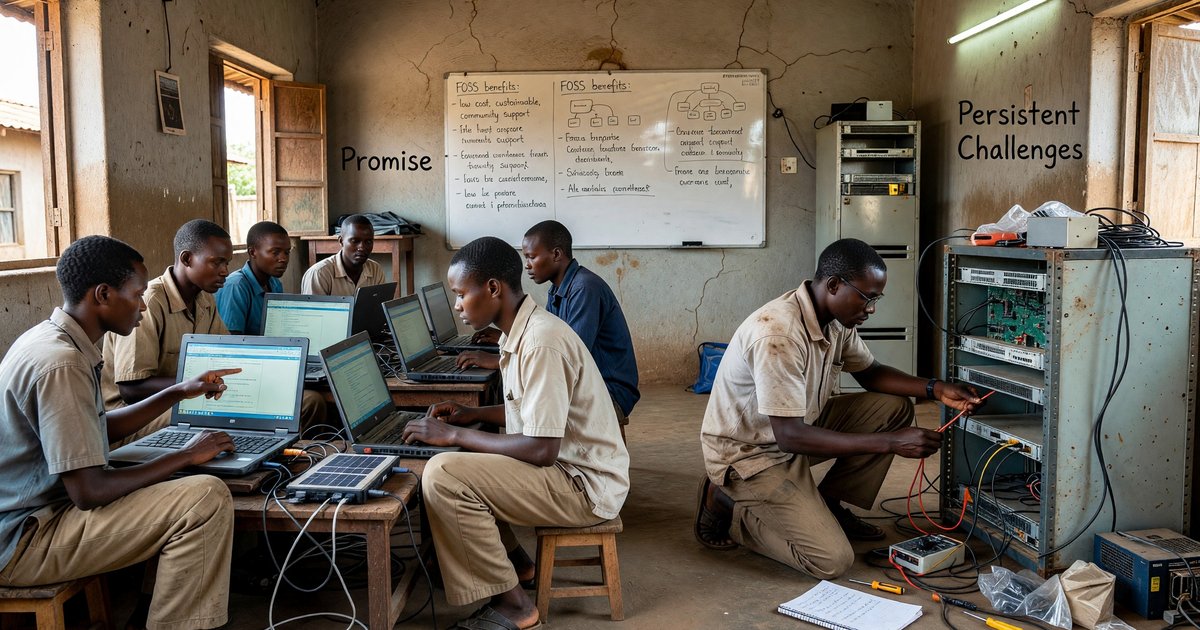
Open source software — software whose source code is publicly available and can be freely used, modified, and redistributed — has been a central tenet of much ICT4D practice since the early 2000s. The appeal is intuitive: development programs operating in resource-constrained environments cannot afford large commercial software licensing fees; open source software eliminates this barrier. And because open source code can be modified, it can theoretically be adapted to local languages, local workflows, and local technical constraints.
This research overview examines the evidence on open source software in ICT4D contexts — where it has delivered on its promise, where it has consistently underdelivered, and what the research literature tells us about the conditions that determine success.
The Case for Open Source in ICT4D
The arguments for open source software in development contexts are well-articulated and have driven significant donor and government investment:
Cost: Eliminating software licensing fees is genuinely significant for organizations with very limited operating budgets. A health ministry implementing an electronic medical records system across 500 clinics faces dramatically different economics depending on whether they pay per-seat licensing fees or use open source software.
Adaptability: Open source code can be modified to fit local needs — local language interfaces, local workflows, local data standards, local regulatory requirements — without requiring negotiation with a commercial vendor. This is theoretically important in contexts where standard global software does not fit.
Sustainability: Dependence on a single commercial vendor for critical system software creates sustainability risk — if the vendor exits the market, raises prices, or discontinues the product, the organization is stranded. Open source software, owned by a community rather than a single company, is theoretically more resilient.
Local technical development: Countries with ICT4D programs built on open source software platforms can develop local technical capacity to maintain and extend the software — building human capital in software development that cannot be built when the underlying software is a black box.
Digital sovereignty: Many development practitioners and governments have argued that open source software is more consistent with national sovereignty over critical information infrastructure than commercial software from large Northern corporations.
Landmark Open Source ICT4D Programs
OpenMRS (Open Medical Record System): Perhaps the most significant open source ICT4D software program, OpenMRS was developed beginning in 2004 by a community of researchers and practitioners (primarily from Regenstrief Institute and Partners in Health) specifically for medical record management in resource-constrained settings. It has been deployed in over 40 countries, with implementations at scale in Kenya, Rwanda, Uganda, Mozambique, and several other African countries. OpenMRS represents the most successful application of open source in ICT4D.
DHIS2 (District Health Information System 2): Developed originally at the University of Oslo and maintained by HISP (Health Information Systems Programme), DHIS2 is now the most widely deployed health management information system in the world, used in over 75 countries for aggregate health data collection, management, and reporting. DHIS2 is an open source success story at national scale.
KoBoToolbox: An open source data collection platform originally developed for humanitarian contexts (by Brigham and Women’s Hospital and Harvard Humanitarian Initiative), KoBoToolbox has become widely used across ICT4D programs for mobile data collection in field surveys, monitoring, and evaluation.
Mifos X / Fineract: Open source software for microfinance management, used by microfinance institutions across Africa, Asia, and Latin America.
Where Open Source Consistently Struggles
The ICT4D literature on open source software documents persistent failure modes that appear across programs and contexts:
The Sustainability-of-Open-Source-Organizations Problem
Open source software requires maintenance — bug fixes, security patches, new versions, adaptation to changing hardware and operating system environments. This maintenance work requires paid developers. The challenge in ICT4D is finding sustainable funding for this maintenance.
The most common funding model is donor-supported development — a foundation, multilateral, or bilateral donor funds a development team to create and maintain software. When funding ends, so does organized maintenance. Projects that achieved initial technical quality and community adoption have declined when funding ran out, because no alternative maintenance model existed.
The most successful open source ICT4D projects (OpenMRS, DHIS2) have achieved sustainability through a combination of mechanisms: a non-profit organization with diverse funders, commercial service providers who charge for implementation and support (creating revenue that funds core development), and government adoption that creates stable institutional demand.
The Fork Problem
Because open source software can be freely modified, implementations in different countries often create country-specific “forks” — customized versions that diverge from the main codebase. These forks are initially useful (local adaptations genuinely improve fit to context) but create long-term problems:
- Forks cannot easily receive updates from the main codebase
- Security vulnerabilities discovered in the main codebase may not be patched in forks
- Country implementations become increasingly isolated from the global development community maintaining the main software
The OpenMRS community has developed explicit governance processes to manage forking — contributing local adaptations back to the main codebase through module systems rather than creating divergent forks. This approach has been partially successful but requires active community management.
The Local Capacity Problem
Open source software can be adapted to local needs — but only if someone has the technical skills to do the adaptation. Local software developers who can work with the codebase are a requirement, not an assumption.
Many countries deploying open source ICT4D software have relied on external technical assistance — development organizations based in high-income countries — for implementation and maintenance. This preserves the cost advantage over commercial software but does not build the local technical capacity that is theoretically one of open source’s key benefits.
Building local ICT capacity that can sustain open source software systems is a longer-term investment than most development projects are designed for.
The Governance Problem
Open source software projects are governed by communities — developers, user organizations, funders, government partners. Community governance can be effective and can make decisions that no single organization could make on its own. It can also be slow, conflict-prone, and vulnerable to capture by dominant players.
ICT4D open source projects have struggled when governance is unclear, when a dominant funder’s interests diverge from the broader user community’s interests, or when technical decision-making authority is concentrated in a small number of developers who may not be accountable to the communities their software serves.
Internet Standards and Open Source
One dimension of the ICT4D open source landscape that is sometimes overlooked: the importance of open standards, distinct from open source software.
The internet’s foundational protocols — TCP/IP, HTTP, DNS, SMTP — are open standards maintained by the Internet Engineering Task Force (IETF) and other standards bodies. These standards are not software (though implementations of the standards are often open source); they are specifications that any software can implement. This openness has been fundamental to the internet’s growth.
In ICT4D contexts, open standards matter for interoperability — the ability of different systems (a mobile money platform, a health record system, a government identity system) to exchange data. Systems built on open standards can be connected without requiring all parties to use the same software platform.
The W3C (World Wide Web Consortium) publishes web standards — HTML, CSS, accessibility guidelines — that are relevant to ICT4D programs developing web-based applications for low-resource contexts. The IETF publishes networking and application protocol standards that underpin the internet infrastructure ICT4D programs depend on.
Frequently Asked Questions
Is open source software always better than commercial software for ICT4D? Not automatically. Open source software eliminates licensing costs but requires investment in local technical capacity for adaptation and maintenance. For organizations with very limited ICT capacity, a well-supported commercial product may actually be more sustainable than open source software that requires technical depth the organization does not have.
What open source health software is most widely used in Africa? DHIS2 is the most widely deployed — used for health management information in the majority of African health ministries. OpenMRS is the most widely deployed electronic medical record system. Together they represent the most successful open source health software programs globally.
How do I contribute to open source ICT4D software? The main communities welcome contributions — bug reports, documentation, code, and user feedback are all valuable. OpenMRS has an active developer community with contribution documentation; DHIS2 has a community of practice that includes both developers and implementers. Coding is not required — user experience feedback, translation, and documentation contributions are also valuable.
What role does the World Bank play in open source ICT4D? The World Bank has funded open source software development, published open source software policy guidance, and in some cases required open source licensing for software developed with its grants. The Digital Public Goods initiative (of which the World Bank is a partner) promotes the development and adoption of open source software, open standards, and open data for development.
Is blockchain relevant to open source ICT4D? Blockchain has attracted ICT4D research attention in areas including supply chain transparency, digital identity, and financial inclusion. Most assessments find that blockchain adds technical complexity without clear advantages over simpler database approaches for most ICT4D use cases. It remains an area of interest but has not produced the transformative applications that advocates have promised.
Further Reading from Authoritative Sources
- W3C Web Standards and Accessibility — The World Wide Web Consortium’s standards documents, relevant to open web standards that underpin ICT4D web application development.
- IETF Internet Standards — The Internet Engineering Task Force’s standards portfolio, covering the open protocols that form the infrastructure layer for ICT4D programs.