Internet Governance and Developing Countries: Participation, Power, and Policy
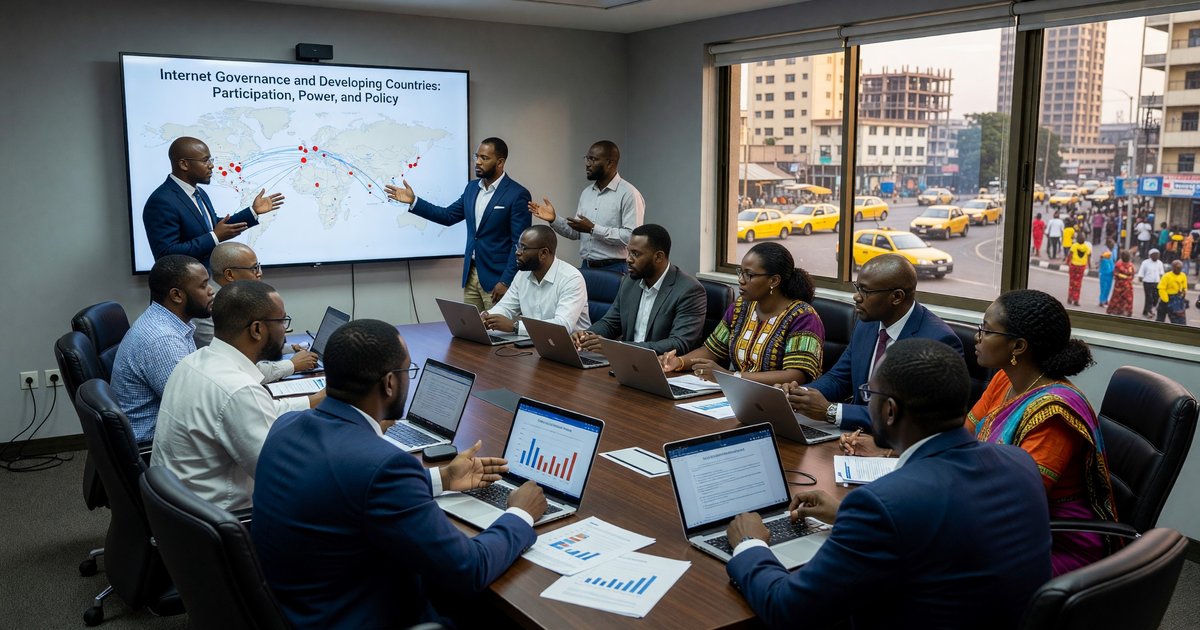
Internet governance — the rules, norms, technical standards, and institutional processes that determine how the global internet is structured, managed, and regulated — is a domain where developing countries have historically been underrepresented and underserved. The internet was built primarily through institutions and by engineers in the United States and Europe, and the governance structures that emerged from that history reflect those origins.
This matters for ICT4D because the technical architecture and governance norms of the internet are not neutral — they determine who can connect and on what terms, what content is accessible, what languages the internet supports, how user data is protected, and how spectrum, addressing resources, and other critical inputs are allocated.
The Landscape of Internet Governance
Internet governance encompasses multiple overlapping domains:
Technical standards: The Internet Engineering Task Force (IETF) develops and maintains the technical protocols of the internet — TCP/IP, HTTP, SMTP, DNS, and hundreds of other specifications. IETF operates on a consensus basis with open participation, though effective participation requires technical expertise and English language fluency that are unevenly distributed.
Internet numbering and addressing: IANA (the Internet Assigned Numbers Authority, now operated by ICANN) allocates IP addresses and domain name registrations. Regional Internet Registries (the five RIRs — ARIN, RIPE NCC, APNIC, LACNIC, and AFRINIC) allocate IP addresses within their regions. AFRINIC serves sub-Saharan Africa.
Domain names and the root: ICANN (Internet Corporation for Assigned Names and Numbers) manages the domain name system and the root zone. ICANN’s multi-stakeholder governance model — involving governments, private sector, civil society, and technical community — has been debated and contested since ICANN’s founding.
Content regulation: Who can publish what, how platforms moderate speech, how illegal content is addressed — these are primarily governed by national laws and by the policies of major platform companies, rather than by any single global institution.
Spectrum allocation: Radio spectrum used for wireless internet is allocated through national spectrum regulators, subject to ITU coordination frameworks for international frequency management.
Developing Country Participation in Internet Governance
Developing country governments, civil society, and technical communities face systematic barriers to effective participation in global internet governance:
Resource constraints: Meaningful participation in IETF, ICANN, the IGF, and other forums requires travel, time, and technical expertise. Small countries with limited foreign ministry capacity and minimal technical community cannot sustain engagement across all relevant governance venues.
Language: IETF and most other governance forums operate primarily in English. Technical document standards, policy discussions, and institutional communications are English-dominant. This creates barriers for participation by communities whose primary languages are not English.
Technical expertise gap: IETF participation requires deep technical expertise in networking protocols. Many developing countries have limited pools of engineers with this expertise, particularly in the Internet governance-specific domain.
Institutional representation: ICANN’s multi-stakeholder model includes geographic diversity requirements for boards and advisory committees, but meaningful representation requires more than formal seats — it requires capacity to engage substantively with the complex technical and policy issues on the agenda.
AFRINIC and African Internet Development
AFRINIC — the African Network Information Centre — is the Regional Internet Registry for Africa, responsible for allocating IP addresses and autonomous system numbers in the African region. Based in Mauritius and operating since 2004, AFRINIC has been a significant institution in the development of internet infrastructure in Africa.
AFRINIC’s responsibilities include:
- Allocating IPv4 and IPv6 address space to African internet service providers and organizations
- Managing the reverse DNS for African IP address space
- Coordinating routing policy and number resource policy for the African region
- Supporting the development of internet technical skills in Africa through training programs
The transition to IPv6 — necessary as IPv4 address space is exhausted — has been slower in Africa than in other regions, in part because of the cost and complexity of upgrading network infrastructure. AFRINIC has been working to accelerate IPv6 adoption, with particular attention to smaller ISPs in African countries.
The Internet Governance Forum (IGF)
The United Nations Internet Governance Forum, established in 2006 following the World Summit on the Information Society (WSIS), is a multi-stakeholder forum for discussion of internet governance issues. The IGF does not make binding decisions but provides a space for governments, private sector, civil society, and technical communities to discuss policy questions.
The IGF has been valuable for developing country participation in several respects:
- It explicitly includes developing country representation, including through funded fellowship programs for civil society participants
- National and regional IGF processes (national IGFs, the EuroDIG, the African Internet Summit) create governance entry points at sub-global scale
- The IGF’s open and non-binding nature reduces the formal barriers to participation compared to binding negotiating processes
Critics note that the IGF’s lack of decision-making authority means participation produces limited influence on actual governance outcomes — governments and companies make the decisions that matter in other forums.
Content and Data Governance: Where Stakes Are Highest
For most people in developing countries, the most consequential internet governance issues are not technical standards or IP addressing but content and data:
Content moderation: The large platform companies (Meta, Google, Twitter/X, TikTok) apply content moderation policies that determine what speech is visible on platforms where billions of people communicate. These policies are developed primarily by companies in the United States and applied globally with limited adaptation to local contexts. Research documents that content moderation disproportionately removes content in non-English languages — because automated systems and human reviewers are less equipped for non-English content — and that what constitutes harmful speech differs across cultures in ways that global policies do not adequately accommodate.
Data localization and privacy: As countries develop data protection laws, many developing countries are debating whether to require that data about their citizens be stored locally. These “data localization” requirements are contested — they can improve privacy and law enforcement access, but can also increase infrastructure costs and restrict cross-border data flows that enable digital services.
Surveillance and government access: The technical architecture of the internet determines whether government authorities (or other actors) can surveil internet communications. Encryption policies, which determine how internet communications are protected, are at the intersection of technical standards and governance policy. Strong encryption protects individual privacy; it also limits government surveillance capacity — a contested trade-off globally, with particular implications for human rights in countries with authoritarian governance.
Frequently Asked Questions
Does the United Nations control the internet? No. The internet does not have a single governing body, and the UN does not control it. Multiple institutions govern different aspects of the internet: IETF for technical standards, ICANN for naming and addressing, national governments for spectrum and content regulation, ITU for international telecommunications coordination. The multi-stakeholder and multi-institutional nature of internet governance is a deliberate design, not a gap.
What is net neutrality and does it matter for developing countries? Net neutrality is the principle that internet service providers should treat all internet traffic equally, without discriminating by source, destination, or content. In developing countries, violations of net neutrality most often take the form of “zero rating” — allowing access to specific services (Facebook, WhatsApp) without counting against data limits. Research on zero rating in Africa and Asia finds that it increases access for specific services but narrows what the internet means for zero-rated users.
What is the W3C’s relevance to ICT4D? The World Wide Web Consortium (W3C) develops web standards — HTML, CSS, and accessibility guidelines. W3C’s Web Accessibility Initiative (WAI) and internationalization standards are directly relevant to ICT4D: they determine whether the web works well for people with disabilities, in non-Latin scripts, in low-bandwidth environments. Active participation in W3C from developers in low-income countries is limited.
What governance concerns specifically affect African internet development? Key concerns include: the pace of submarine cable investment and internet exchange point (IXP) development that determines how much international internet traffic is routed locally vs. through expensive Northern hubs; spectrum allocation policies that affect mobile broadband expansion; AFRINIC’s IP address allocation policies; and national-level regulatory frameworks for ISPs.
What is the IETF doing for low-bandwidth contexts? The IETF has working groups on “low-power wide area networks” (LPWAN) and on internet operation in “constrained” environments — relevant to IoT and remote sensor applications. The IETF’s work on HTTP/3 and QUIC protocols improves performance in high-latency, unreliable connections common in developing country contexts. However, the IETF’s primary focus is on the technically sophisticated global internet rather than specifically on low-bandwidth ICT4D applications.
Further Reading from Authoritative Sources
- ITU Internet Governance Framework — The International Telecommunication Union’s resources on the World Summit on the Information Society (WSIS) and the internet governance framework it established.
- IETF Internet Standards and Open Technical Governance — The Internet Engineering Task Force’s overview of its open standards development process and how technical internet governance works.