What Is ICT4D? Information and Communication Technology for Development Explained
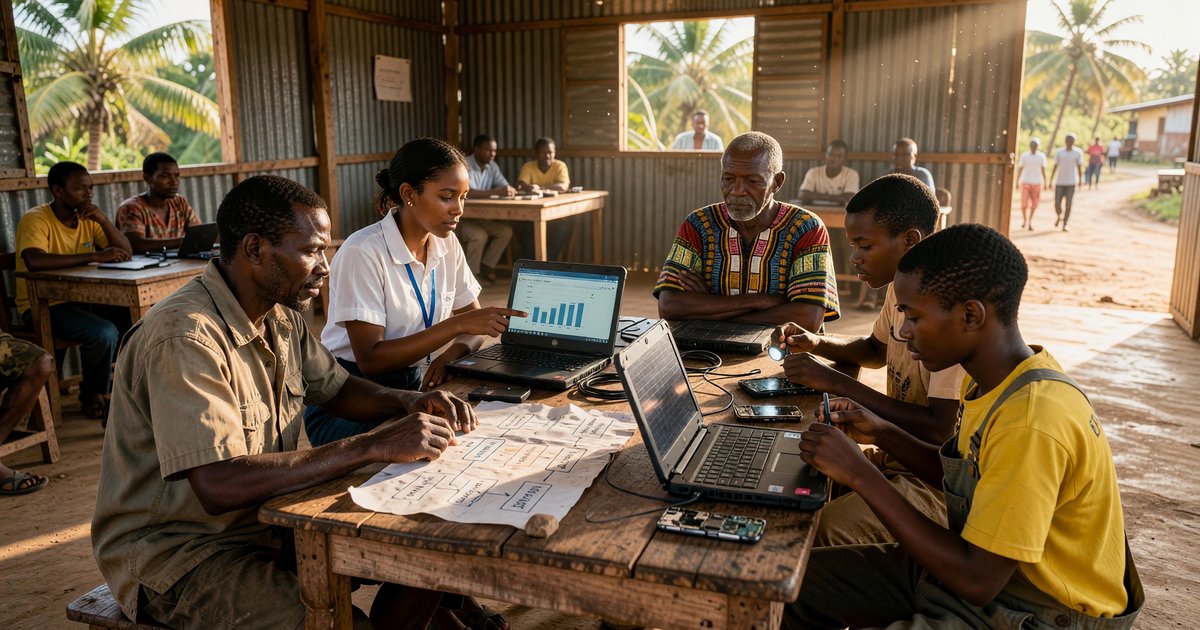
Information and Communication Technology for Development — commonly abbreviated ICT4D — is an interdisciplinary field examining how digital technologies interact with economic, social, and institutional development processes, particularly in low- and middle-income countries. The field sits at the intersection of information systems, development economics, public policy, and sociology, drawing on methods from all of these disciplines to understand a central question: when does technology help, when does it fail to help, and why?
This overview introduces the field’s intellectual origins, its major analytical frameworks, and the debates that continue to shape research in the area today.
Origins of the Field
ICT4D as a recognizable academic field emerged in the 1990s and early 2000s, driven by the rapid global spread of mobile telephony and, later, internet connectivity. Before then, researchers working on technology and development operated mostly within established disciplines — economists studied the macroeconomic effects of technology adoption; sociologists examined how organizations adapted to computing; anthropologists documented how communities made sense of new media.
What distinguished ICT4D as its own field was a focus on the specific conditions of low-resource contexts — weak institutional infrastructure, unreliable power, low literacy, high poverty, limited state capacity — and on whether technology could help address development challenges in those conditions.
The early wave of ICT4D research was often associated with “telecentre” projects: physical community computing centers established in rural or peri-urban areas of developing countries, offering shared access to computers and internet in contexts where individual ownership was not viable. Studies of telecentres in South Africa, India, Ghana, and elsewhere produced the first large body of field-based evidence on technology adoption in development contexts.
The “Great Debate” in ICT4D
By the mid-2000s, a major intellectual tension had emerged in the field, sometimes called the “Great Debate” between optimists and skeptics.
Technology optimists argued that ICT created new opportunities to leapfrog traditional development constraints. Mobile telephony, for example, allowed rural areas to gain telecommunications access without building fixed-line infrastructure. Digital financial services could give the unbanked access to payment and savings systems without physical bank branches. These views were influential in donor organizations, international agencies, and technology companies entering development markets.
Skeptics and critical theorists argued that technology-optimistic framings ignored underlying structural causes of underdevelopment — land tenure, governance failures, colonial legacies, inequality — and risked diverting resources and attention toward technological “solutions” that addressed symptoms rather than causes. They noted that technology adoption was often uneven, frequently bypassing the poorest and most marginalized populations, and that digital infrastructure investment could widen existing inequalities.
This debate has not been resolved, but it has become more nuanced. Most contemporary ICT4D researchers reject simple technological determinism in either direction — neither that technology automatically improves development outcomes, nor that it is inherently irrelevant or harmful. The productive question has shifted to: under what conditions does which type of technology, deployed by whom, produce what kinds of development outcomes for which populations?
Key Analytical Frameworks
The Capabilities Approach
The capabilities approach, developed by economist and philosopher Amartya Sen and extended by Martha Nussbaum, evaluates development not in terms of income or growth but in terms of what people are actually able to do and be — their “capabilities.” ICT4D researchers working within this framework ask not whether technology increases GDP or productivity, but whether it expands substantive human freedoms: the ability to access information, participate in political life, maintain health, engage in economic activity on one’s own terms.
Social Informatics
Social informatics examines how information technologies are shaped by, and in turn shape, social practices and structures. In ICT4D contexts, this means looking beyond the technology itself to the organizational, institutional, and cultural contexts in which it is deployed — and being skeptical of assumptions that technology produces uniform effects regardless of context.
Design for Values / Participatory Design
Participatory design approaches involve intended users and communities as active co-designers rather than passive recipients of technology. In ICT4D contexts, this means working with communities to understand their priorities, constraints, and existing information practices before designing systems, rather than arriving with pre-built solutions.
Developmental Evaluation
Developmental evaluation is an approach borrowed from the evaluation literature that treats complex development interventions — including ICT4D projects — as requiring ongoing learning and adaptation rather than pre-specified outcomes measurement. It is suited to ICT4D contexts where the causal pathways between technology deployment and development outcomes are uncertain and context-dependent.
Major Research Themes
Mobile money and financial inclusion: The M-Pesa system in Kenya, launched in 2007, became the most-studied ICT4D case in the world — demonstrating that mobile-based financial services could reach populations excluded from formal banking. Subsequent research has examined adoption patterns, economic effects, and attempts to replicate M-Pesa’s model in other contexts.
Agricultural information systems: Farmers in low-resource contexts face information asymmetries on prices, weather, and inputs. Several ICT4D programs have sought to address these through SMS-based advisory services, mobile market price information systems, and digital extension services.
Digital health: From electronic medical records in under-resourced health systems to telemedicine platforms connecting rural patients with urban specialists, digital health has been a major application domain for ICT4D.
E-government and civic technology: Digital systems for public service delivery — land registry digitization, digital identity, electronic voting — raise questions about state capacity, inclusion, and the politics of who gets served by digital government.
Current Research Frontiers
The most active research fronts in contemporary ICT4D include:
- Platform economies and the Global South: How do ride-hailing, gig economy, and digital marketplace platforms affect informal workers and small enterprises in low- and middle-income countries?
- Artificial intelligence for development (AI4D): What kinds of AI applications are being deployed in development contexts, by whom, with what effects on inequality and agency?
- Digital identity systems: The rapid spread of biometric and digital identity infrastructure raises questions about inclusion, surveillance, and institutional capacity.
- Offline-first and low-bandwidth design: Designing for users who have intermittent or expensive connectivity remains a persistent challenge in ICT4D.
Frequently Asked Questions
What is the difference between ICT4D and digital development? “Digital development” is a broader and more recent term used by international organizations (World Bank, UNDP) to cover the same general domain. ICT4D is the older, more academically established term. In practice, the terms are often used interchangeably, though ICT4D tends to appear more in academic literature.
Is ICT4D only relevant to sub-Saharan Africa? No. ICT4D research covers low- and middle-income contexts globally — South Asia, Southeast Asia, Latin America, the Pacific Islands, and the Middle East, as well as Africa. Much foundational research came from African contexts because of their combination of rapid mobile adoption and significant development challenges, but the field is global.
What academic journals publish ICT4D research? The leading journals include Information Technology for Development (Taylor & Francis), The Electronic Journal of Information Systems in Developing Countries (Wiley), and Information Technologies & International Development (MIT Press). Conference proceedings from IFIP WG 9.4 and the former IDIA series are also important publication venues.
How does ICT4D relate to computer science or software engineering? ICT4D is primarily a social science field, not a technical one. Its questions are about adoption, impact, equity, and institutional change — not system design per se. However, it has productive connections with fields like human-computer interaction (HCI), design, and software engineering, particularly through participatory and community-centered design approaches.
What development agencies fund ICT4D work? Major funders include the World Bank (through its Development Impact Group and Digital Development unit), UNDP, USAID (through its Digital Strategy), the UK’s FCDO, the Gates Foundation, and various bilateral development agencies. Academic research is also funded through national research councils in the UK, Netherlands, Scandinavia, and increasingly African countries.
Further Reading from Authoritative Sources
- ICT for Development on Wikipedia — Wikipedia’s overview of the ICT4D field, including its history, major research themes, and institutional context.
- World Bank Digital Development — The World Bank’s digital development hub covers how the institution approaches ICT in its development programs, including research, policy guidance, and project documentation.
For deeper dives into specific ICT4D topics, see our case study on M-Pesa and mobile money in Kenya and our research overview of the digital divide in the Global South.