Digital Identity Systems in the Global South: Inclusion, Exclusion, and Design
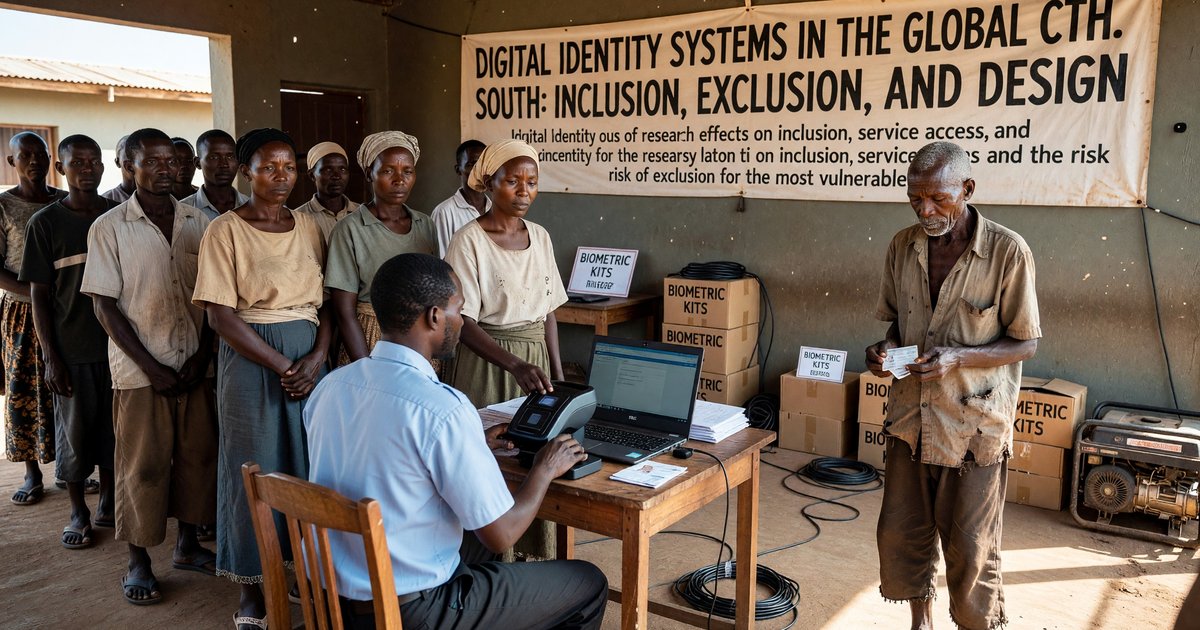
The ability to prove who you are is foundational to accessing most formal services — banking, healthcare, government benefits, and legal employment all require identity verification in most institutional settings. In low-income countries, large fractions of the population — often 30–50 percent in sub-Saharan Africa — lack any formal identity documentation. Digital identity systems, which use biometric and digital methods to register and verify identity at scale, have been positioned as a solution to this exclusion.
The scale of digital identity investment in the Global South has been extraordinary. India’s Aadhaar system registered over 1.3 billion people. Several African countries have deployed national biometric ID programs with World Bank and bilateral donor support. The ID4D (Identification for Development) initiative at the World Bank has documented and supported digital identity programs across dozens of countries.
The research literature on these programs is more ambivalent than the development rationale suggests.
Why Digital Identity Matters for Development
The development rationale for digital identity systems rests on several mechanisms:
Service access: Formal healthcare, banking, and government program access typically requires identity verification. People without documentation are often effectively excluded from these services, regardless of their eligibility. Digital ID can provide documentation to the previously undocumented.
Financial inclusion: KYC (Know Your Customer) regulations require financial institutions to verify customer identity. Mobile money services that handle larger transactions require identity verification. Digital ID systems linked to mobile number registration can enable financial service access for people who previously lacked qualifying documentation.
Social protection delivery: Government cash transfer programs, food programs, and pension systems require identifying beneficiaries accurately to prevent fraud and ensure payments reach intended recipients. Digital identity systems can improve both accuracy and efficiency of social protection delivery.
Civic participation: Voter registration and political participation depend on identity systems. Digital voter registration with biometric deduplication can reduce double registration and improve election integrity.
The Inclusion Promise vs. Exclusion Risk Paradox
The fundamental tension in digital identity research is this: systems designed to include the previously excluded can simultaneously create new forms of exclusion.
Biometric Registration Failures
Biometric systems rely on high-quality fingerprint, iris, or facial scans. Several populations face systematic challenges with biometric registration:
Manual laborers and elderly people often have worn or damaged fingerprints that do not register clearly in biometric systems. Agricultural workers, construction workers, and people who have done heavy manual labor for decades may not be able to register fingerprints at all with standard enrollment equipment.
People with disabilities face a range of biometric challenges — visual impairments affecting iris scans, limb differences affecting fingerprint enrollment, facial features affected by injury or disease.
Remote and rural populations may face distance barriers to enrollment centers that are concentrated in urban areas. Enrollment campaigns that require travel of tens of kilometers to a district center effectively exclude those who cannot make the journey.
Research on India’s Aadhaar system documented biometric registration failure rates of 15–20 percent for manual laborers in some field studies — a substantial fraction of the target population for a system intended to include the marginalized.
Documentation Catch-22
Many digital identity programs require prior documentation to enroll — a birth certificate, a witness statement from a community leader, or some alternative identity verification. This creates a catch-22: the populations most in need of digital ID (those who lack documentation) are also those least able to satisfy the enrollment prerequisites.
Thoughtful ID system design addresses this through tiered enrollment (different levels of documentation required for different levels of access) and community-based enrollment processes that allow peer verification. Programs that do not address the catch-22 systematically exclude their target population.
Connectivity-Dependent Verification
Online verification systems — where ID is verified in real time against a central database — fail when connectivity is unavailable. In contexts with unreliable power and internet, verification failures block access to services for the duration of the outage. Designing for offline operation (through smart cards, locally cached credentials, or other mechanisms) is a design choice with significant implications for reliability in low-resource environments.
India’s Aadhaar: A Landmark and a Controversy
India’s Aadhaar system, launched in 2009 and reaching near-universal enrollment by the late 2010s, is the world’s largest digital identity system and has generated more ICT4D research and policy debate than any comparable program.
The positive record: Aadhaar has enabled significant improvements in social protection delivery. Linking benefit payments to Aadhaar authentication has reduced “ghost beneficiaries” (fraudulent beneficiaries) in several programs and reduced the cost and friction of payment delivery for legitimate beneficiaries.
The exclusion controversy: Researchers and civil society organizations have documented cases where Aadhaar-linked authentication failures prevented genuine beneficiaries from accessing food rations, pensions, and other entitlements. The scope of authentication failure — and whether the harm from exclusion exceeded the benefit from fraud reduction — was a major policy debate.
The surveillance concern: Aadhaar’s architecture — linking biometric identity to a central database that is accessed in real time for service authentication — creates a comprehensive record of who accesses which services when. Civil liberties organizations in India argued this created infrastructure for surveillance incompatible with privacy rights. The Indian Supreme Court in 2018 upheld Aadhaar’s core legality while imposing limits on its use.
The design lesson: Aadhaar’s experience illustrates that the design choices in identity systems — centralized vs. distributed, online-only vs. offline-capable, mandatory vs. voluntary — are not neutral technical choices but have profound implications for inclusion, privacy, and rights.
Better Design Principles for Inclusive Digital Identity
Research on digital identity programs has contributed a set of design principles that reduce exclusion risk:
Multiple biometric modalities with alternatives: Systems that accept fingerprint, iris, and facial biometrics, with fallback to documentary verification or witness-based enrollment for those who cannot provide any biometric, are more inclusive than single-modality systems.
Offline-capable credentials: Smart card-based systems that store credentials locally and can be verified offline are more reliable in low-connectivity environments. The trade-off is higher card issuance and management costs.
Tiered service access: Not all service access requires the same identity verification level. High-value transactions require stronger verification; basic service access (attending a health clinic, receiving food assistance) should not be blocked by authentication failure. Tiered systems allow meaningful access without perfect authentication.
Community enrollment processes: Enrollment campaigns that bring enrollment infrastructure to communities (rather than requiring people to travel to enrollment centers), that use community-based validation processes for those who lack prior documentation, and that explicitly target marginalized populations reach the most excluded.
Privacy by design: Minimizing the data collected, limiting the linkability of records across different service domains, and building in technical protections against misuse should be design requirements rather than afterthoughts.
Frequently Asked Questions
Do digital identity programs reach the poorest? Evidence is mixed. Programs with active community enrollment and tiered access have reached populations at the bottom of the income distribution. Programs that require initial documentation, travel to enrollment centers, or reliable online connectivity have systematically underenrolled the poorest and most marginalized.
What is the World Bank’s position on digital identity? The World Bank’s ID4D (Identification for Development) initiative promotes digital identity as a tool for development, while also publishing design principles and research on exclusion risks. The World Bank has funded digital identity programs in dozens of countries, typically with guidance on design principles that address inclusion.
Is mandatory enrollment in digital ID systems a violation of rights? Contested. Mandatory enrollment has been implemented in several countries, including India (for certain benefits). Courts in some countries (including India) have found mandatory enrollment constitutionally problematic, particularly when linked to essential services like food security. Human rights organizations have argued that voluntary enrollment is a design requirement for rights compliance.
What role does international standards play in digital identity? The ITU, the IETF, and ISO publish technical standards for identity systems that inform national implementations. Standards for biometric data formats, identity verification protocols, and data exchange formats enable interoperability and provide a baseline for quality. The World Bank’s ID4D initiative also publishes “Principles on Identification for Sustainable Development,” which are referenced in many national program designs.
How does digital identity interact with refugee populations? Refugees and displaced populations face particular challenges with digital identity — documentation may have been lost, national identity systems of origin countries are not accessible, and host country systems may not include non-citizens. The UNHCR has been developing digital identity approaches for refugee populations, including biometric registration through its own systems.
Further Reading from Authoritative Sources
- World Bank ID4D: Identification for Development — The World Bank’s flagship digital identity program, including research on exclusion risks, design principles, and country program documentation.
- UNDP Digital Identity and Inclusion — UNDP resources covering digital identity in the context of digital development and inclusive growth programs.