Digital Health in Low-Income Countries: Evidence, Gaps, and the Path to Scale
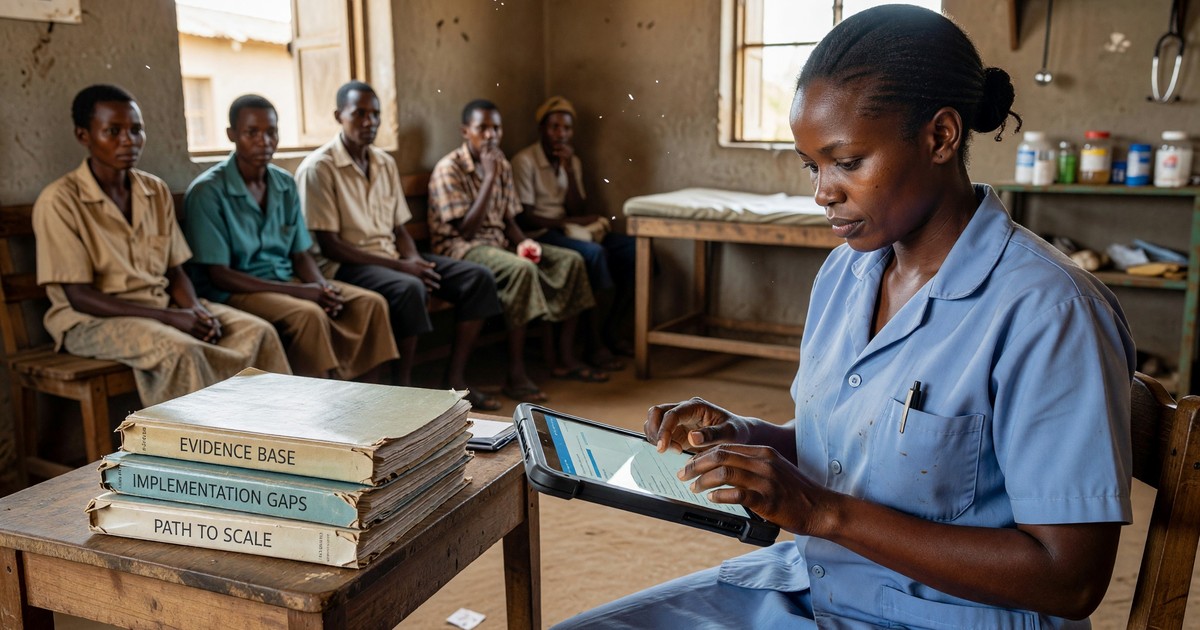
Digital health — the use of information and communication technologies in healthcare delivery — has attracted enormous investment in low- and middle-income countries over the past two decades. The promise is compelling: mobile phones in the hands of community health workers, electronic medical records in rural clinics, telemedicine connecting remote patients to urban specialists. Each represents a genuine opportunity to extend healthcare reach in contexts where infrastructure, workforce, and resource constraints make conventional healthcare delivery difficult.
This article reviews the ICT4D evidence base on digital health in low-resource settings — what works, what does not, and why implementation so frequently falls short of the promise.
The Scale of the Problem These Technologies Are Addressing
The healthcare gap in low-income countries is profound. According to the World Health Organization, low-income countries have approximately 1 physician per 10,000 population, compared to over 30 per 10,000 in high-income countries. Health worker shortages mean that formal clinical care is inaccessible for large portions of rural populations.
Community health worker (CHW) programs have been one response to this shortage — deploying community members with targeted training to provide primary care, prevention, and referral at the village level. Programs like Ethiopia’s Health Extension Program and Ghana’s Community Health Planning and Services (CHPS) have demonstrated that CHW programs can improve measurable health outcomes at population scale.
Digital health technologies are often positioned as CHW multipliers — tools that extend what community health workers can do, improve data quality, support clinical decision-making, and enable supervision at scale.
Digital Health Applications and Evidence by Category
Mobile Health (mHealth) for CHW Support
The most extensively evaluated category of digital health in low-resource settings is mobile phone-based support for community health workers. Applications include:
- Data collection: CHWs using mobile forms (Open Data Kit, KoBoToolbox, CommCare) rather than paper registers to record patient encounters, improving data completeness and speed
- Decision support: Clinical algorithms delivered via mobile phone that help CHWs triage symptoms and make referral decisions
- Supervision and feedback: Real-time data from CHW reporting enabling supervisors to identify problems and provide support remotely
The evidence on mHealth for CHW support is mixed but generally positive for process outcomes (data quality, completeness, timeliness) and more ambiguous for health outcomes (reduced mortality, improved clinical indicators). A systematic review published in BMC Health Services Research (2019) found that mHealth tools consistently improved data quality but showed less consistent effects on clinical outcomes — partly because the distance between improved data and improved outcomes is long and depends on many non-technological factors.
Electronic Medical Records in Resource-Constrained Settings
Electronic health records (EHR) systems have been deployed in public health facilities across sub-Saharan Africa and South Asia, often with donor funding from PEPFAR, the Gates Foundation, and bilateral donors. OpenMRS (an open-source medical records system developed specifically for resource-constrained settings) has been deployed in over 40 countries.
The evidence on EHR implementation in low-resource settings is sobering: implementation failure rates are high, and sustainability after initial donor funding is a persistent challenge. Common failure modes include:
- Infrastructure constraints: Unreliable power and internet connectivity undermine system reliability; clinicians lose trust in systems that fail frequently
- Training and turnover: Healthcare worker turnover is high in many low-income settings; continuous training requirements exceed capacity
- Workflow integration: EHR systems designed in high-income contexts do not fit the workflow realities of under-resourced clinics
- Maintenance: Software maintenance and hardware replacement require sustained investment that is often not planned for after initial implementation
Where EHR systems have sustained, the common enabling factors are: local technical capacity (ability to customize, debug, and maintain), integration into routine workflow rather than addition to it, and continued management attention to system performance.
Telemedicine and Remote Consultation
Telemedicine — connecting patients or health workers in remote areas with specialists in urban centers — has expanded in low-resource settings, particularly for dermatology, radiology, mental health, and specialist consultation. Mobile network coverage improvements have made video consultation increasingly feasible.
The COVID-19 pandemic accelerated telemedicine adoption in many countries, and subsequent evidence suggests sustained uptake in some contexts. However, telemedicine in low-resource settings faces specific barriers:
- Connectivity quality: Reliable video requires sustained bandwidth that many rural connections cannot provide
- Device availability: Patients and health workers need compatible devices; smartphone penetration in rural areas is growing but not universal
- Clinical information asymmetry: Telemedicine works best when the patient is examined in person by someone (a CHW or nurse) who can share findings with the remote specialist; purely patient-facing telemedicine without local clinical support has limited value for many conditions
Disease Surveillance and Outbreak Response
Digital surveillance systems — from mobile-based reporting of syndromic cases by CHWs to more sophisticated integrated disease surveillance and response (IDSR) platforms — have been a significant investment area in global health security. The COVID-19 pandemic provided the most demanding test of these systems.
Evidence from Africa CDC and WHO evaluations found that countries with more developed digital surveillance infrastructure responded more effectively to COVID-19 in several respects — faster case identification, more reliable data for resource allocation, and better coordination of response. However, data quality remained a challenge, and surveillance systems showed limited benefit in the absence of strong epidemiological and response capacity.
The Implementation Gap: Why Digital Health So Often Falls Short
The gap between digital health’s theoretical potential and its documented reality is a major research theme. A landmark analysis by Whorl et al. (frequently cited in the ICT4D literature) examined over 1,000 mHealth projects globally and found that the vast majority were small-scale pilots that never reached the sustainability or scale that would produce population-level health impact.
Explanatory factors include:
The “pilotitis” problem: The development funding cycle rewards innovation — launching new pilot projects — over scaling and sustaining what works. This creates a permanent state of proof-of-concept projects that never become operational programs.
Technology-first design: Many digital health initiatives begin with a technology solution and look for a problem to fit it, rather than beginning with a carefully characterized problem and asking whether technology is the right solution.
Neglect of the “software stack” above the application: Even a well-designed mHealth application requires a functioning health system around it — trained workers to use it, supply chains to fill prescriptions it recommends, referral systems to receive the patients it identifies. Digital technology cannot substitute for these system-level requirements.
Short funding cycles: Pilot funding rarely covers the 3–5 year period needed to learn whether a digital health intervention produces sustained health outcomes. Most evaluations measure process outcomes (data quality, CHW adherence) rather than clinical outcomes.
What Successful Digital Health Programs Have in Common
Research syntheses on successful digital health programs in low-resource settings consistently identify several common factors:
Government ownership: Programs integrated into government health systems from the beginning — not NGO-owned parallel systems — are more likely to sustain.
Human-centered design: Programs designed with and for the health workers and patients who will use them show higher adoption and more effective use.
Infrastructure investment: Investment in power backup, device maintenance, and connectivity is as important as application development.
Local technical capacity: Countries and health systems that have invested in local ICT capacity — software developers, database administrators, network engineers — are more successful at sustaining health information systems.
Realistic scope: Programs that begin with a narrow, clearly defined use case and demonstrate value before expanding have better success rates than comprehensive digital health platforms.
Frequently Asked Questions
Does digital health improve health outcomes in low-income countries? The honest answer is: sometimes, for specific interventions, under favorable conditions — but the overall evidence base is weaker than the level of investment and enthusiasm would suggest. Process improvements (data quality, efficiency) are better documented than health outcome improvements (reduced mortality, improved clinical indicators).
What is the role of artificial intelligence in digital health for low-income countries? AI applications in digital health for LMICs include diagnostic imaging tools (chest X-ray reading for TB, diabetic retinopathy screening), clinical decision support, and disease prediction models. Evidence is early but promising for specific narrow applications. Concerns include bias in AI systems trained on high-income-country data and applied in different demographic contexts.
How does PEPFAR support digital health? The US President’s Emergency Plan for AIDS Relief (PEPFAR) has been a major funder of electronic health records and health information systems in sub-Saharan Africa, specifically for HIV/AIDS program management. OpenMRS adoption in several countries was driven by PEPFAR funding and technical assistance.
What is the difference between eHealth and mHealth? eHealth broadly covers the use of electronic processes and communication in healthcare — including health information systems, electronic records, and health portals. mHealth is a specific subset focused on mobile phone-based applications. In resource-constrained settings, mHealth is more prominent because mobile phones are far more widespread than desktop computers.
Are there digital health systems that have successfully scaled in low-income countries? Yes — several. Ethiopia’s DHIS2 implementation for health management information is frequently cited as a successful large-scale deployment. Rwanda’s health information system, supporting one of Africa’s strongest health systems, includes significant digital components. The Philippines’ national health information system has scaled significantly. Common factors: government ownership, sustained investment, and local technical capacity.
Further Reading from Authoritative Sources
- UN Digital Health Resources — The United Nations’ health-related resources include coverage of digital health programs and the SDG health targets that ICT4D health programs aim to support.
- World Bank Health Technology Resources — World Bank health sector resources include documentation and evaluation of health information system investments in low- and middle-income countries.