Action Research in ICT4D: Method, Ethics, and Field Application
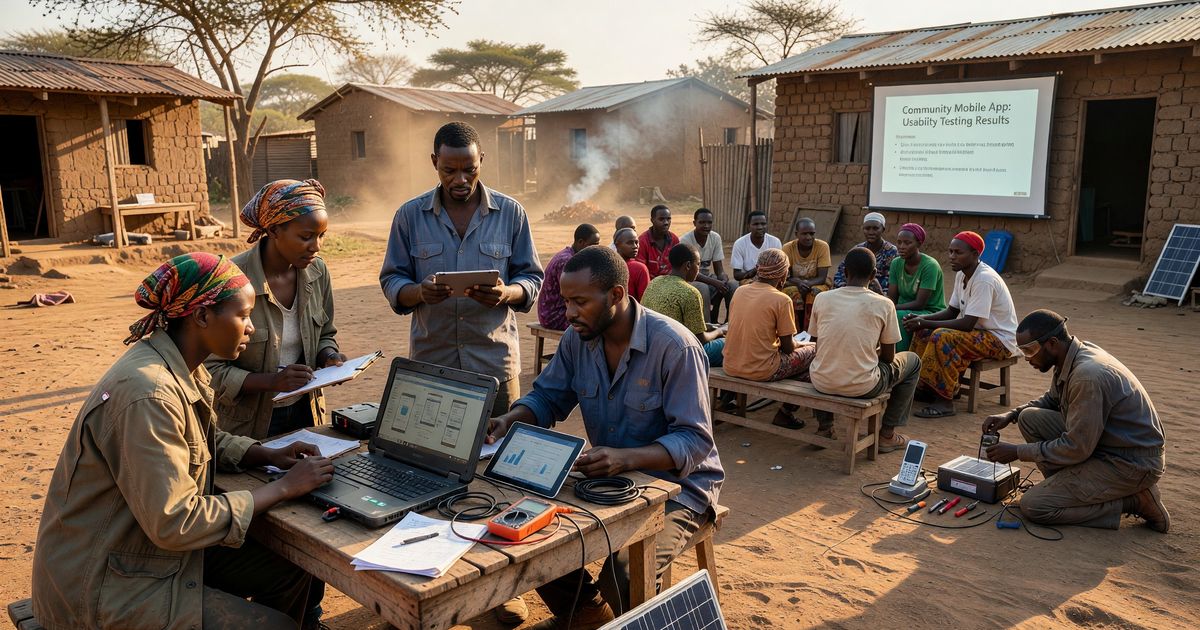
Action research is a research methodology that deliberately blurs the conventional line between research and intervention. Where conventional social science research aims to study a phenomenon while minimizing the researcher’s effect on it, action research explicitly combines inquiry with action — the researcher does not just observe and analyze, but actively works with participants to understand problems and develop responses, in cycles of action, reflection, learning, and further action.
In ICT4D contexts, action research is particularly well-suited to work that cannot responsibly separate the research from the development: when researchers are embedded with organizations or communities implementing ICT projects, when the research itself is part of a development intervention, or when the research aims to produce actionable knowledge for practitioners rather than purely theoretical contributions.
What Action Research Is and Is Not
Action research is frequently misunderstood. It is not:
- Simply consulting with practitioners. Traditional applied research may consult with practitioners, but the research design, questions, and analysis are controlled by the researcher. In action research, practitioners are co-inquirers in the process.
- Case study research. A case study documents and analyzes what happens in a setting. Action research changes what happens while documenting and analyzing it.
- Project evaluation. Evaluation assesses outcomes against predetermined criteria. Action research explores open-ended questions about what is happening and why, while the answers may change the project itself.
Action research is a form of iterative, collaborative inquiry that produces two outputs simultaneously: change in the situation being studied, and knowledge about that situation. Both outputs are legitimate and intended.
Theoretical Roots
Action research as a formal methodology is attributed primarily to Kurt Lewin, the social psychologist who coined the term in the 1940s. Lewin worked with community organizations on practical social problems and argued that effective research on social systems had to be done in partnership with the people living and working in those systems.
The tradition was extended significantly by participatory action research (PAR), associated with researchers like Paulo Freire (education for critical consciousness), Orlando Fals Borda (Colombian sociology), and Orlando Fals-Borda’s collaborators in Latin American social movements. PAR emphasized the political dimension of action research: the right of communities to generate knowledge about their own situations, rather than being objects of external research.
In ICT4D, these traditions converge. The field’s commitment to producing contextually relevant knowledge — not just abstract theory — and its engagement with communities as partners rather than subjects makes action research a natural methodological fit.
The Action Research Cycle
Most action research frameworks describe an iterative cycle of:
- Diagnosing: Identifying a problem or area for inquiry, in collaboration with practitioners and community members
- Planning: Developing an action response — what change will be attempted?
- Acting: Implementing the planned action
- Observing: Documenting what happens as the action unfolds
- Reflecting: Making sense of observations; what worked, what did not, and why?
- Re-diagnosing: Using reflections to refine understanding and plan the next cycle
This cycle repeats — sometimes quickly (weekly reflection cycles within an active ICT implementation) and sometimes slowly (semester-length cycles in a university partnership). The number of cycles, their duration, and the depth of reflection at each stage depend on the research context and questions.
Action Research in ICT4D Practice
ICT4D action research takes several common forms:
Embedded Researcher in ICT Implementation
A researcher is embedded with an organization implementing an ICT project — a national health information system deployment, an agricultural information service, an e-government portal. The researcher participates in implementation activities, documents what happens, facilitates reflection within the implementation team, and feeds learning back into the implementation in real time.
This model is particularly useful for understanding implementation challenges that cannot be studied retrospectively — the way problems are noticed, communicated, and addressed in real time, and how those processes affect ultimate outcomes.
Researcher as ICT Project Initiator
In some ICT4D action research, the researcher is not just embedded in an existing project but initiates an ICT project specifically as a research vehicle. The project serves dual purposes: a genuine development intervention and a controlled inquiry into specific questions about ICT and development.
This model raises ethical questions: is the project genuinely serving the community’s interests, or is it primarily a research vehicle? These are not mutually exclusive, but the researcher’s obligations to the community must be primary.
Collaborative Research With Community Organizations
Community organizations — health NGOs, farmers’ groups, women’s cooperatives, disability organizations — are engaged as co-researchers, helping define research questions, collect data, and interpret findings. The research addresses a problem the organization has identified; the research outputs are designed to be useful to the organization, not just to academic publication.
Quality and Rigor in Action Research
One of the persistent critiques of action research, particularly from positivist social science traditions, is that it lacks the controls necessary for rigorous causal inference. If the researcher is simultaneously acting and observing, how can they be confident that observed changes resulted from the intervention rather than other factors?
Action researchers respond to this critique with alternative quality criteria:
Catalytic validity: Does the research produce change that the community values? A finding that is statistically impeccable but generates no useful action fails this criterion.
Process validity: Was the inquiry process itself rigorous — were multiple perspectives included, were assumptions made explicit, was reflection genuine rather than pro forma?
Dialogic validity: Did the research findings emerge from genuine dialogue between researcher and participants, or were they imposed by the researcher?
Outcome validity: Do the outcomes address the problem that motivated the research?
These criteria do not claim equivalence with experimental rigor — they claim a different but legitimate form of rigor appropriate to the goal of producing actionable knowledge in context.
Ethical Considerations in ICT4D Action Research
Action research raises ethical issues beyond those of conventional research:
Informed consent for ongoing intervention: Participants consent to participate in research, but in action research, the nature of that participation changes as the cycles proceed. Initial consent forms cannot fully describe what later research activities will involve. This requires ongoing consent processes and transparency about how the research is evolving.
Power in the research relationship: Action research claims collaborative inquiry, but researchers often have more formal education, more resources, more language facility in the research’s publication language, and more institutional backing than community participants. These power differentials affect what questions are asked, whose knowledge is valued, and who benefits from the research outputs.
Publication and attribution: Research published from action research belongs to the academic publication system, which attributes authorship to individuals and institutions. The community members who were co-inquirers may not appear as authors, may not have access to the journal, and may not be acknowledged for their contributions in ways meaningful to them.
Exit: Action research creates relationships and dependencies. When the research project ends, the researcher may leave, but the intervention continues — or fails. Responsibility for what happens after the researcher exits is a genuine ethical obligation.
Frequently Asked Questions
Is action research only qualitative? No. While action research is often associated with qualitative methods (interviews, observation, document analysis), it can incorporate quantitative data collection and analysis where that serves the research questions. The defining characteristic of action research is not its methods but its orientation toward action, collaboration, and iteration.
Can action research produce generalizable findings? Action research produces “transferable” rather than “generalizable” findings. Rather than claiming that findings apply universally (generalizability), action research produces thick descriptions of particular situations and explicit accounts of the conditions under which specific approaches worked — allowing readers in other contexts to assess whether and how findings might transfer.
How do I write up action research for academic publication? Academic publication of action research requires articulating the research design, including the cycles of action and reflection, the role of the researcher, and the ways findings emerged from the process. Journals that publish action research include journals in information systems, education, organization studies, and some ICT4D-specific venues.
What is the difference between action research and consulting? The line can be thin. The key distinctions are: research produces and makes public new knowledge; consulting produces private knowledge for the client. Research maintains methodological standards for how knowledge is generated; consulting is evaluated on whether it solves the client’s problem. Researchers have obligations to truth and to participants beyond their agreement with any specific organization; consultants’ primary obligation is to the client.
Does IDIA publish action research? The IDIA conference series published both empirical research (case studies, surveys) and methodological papers, including action research. The conference attracted a mix of research orientations, and action research papers appeared across the series.
Further Reading from Authoritative Sources
- UNDP Evaluation Guidelines: Developmental Evaluation — UNDP’s evaluation resources cover developmental evaluation approaches that share conceptual ground with action research in complex adaptive settings.
- Wikipedia: Action Research — An overview of action research as a methodology, covering its origins, key variations, and application across social science disciplines.