IDIA 2012: Research Highlights and Key Themes from the Conference
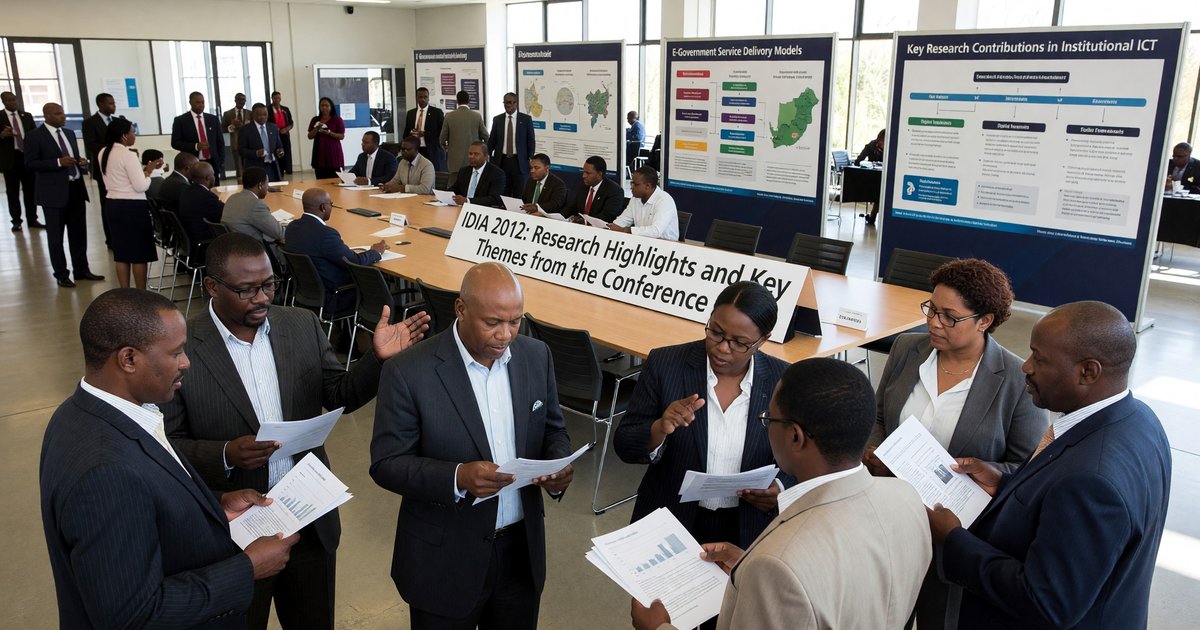
The 2012 International Development Informatics Association conference marked a point of maturity for the series. By its sixth year, IDIA had established itself as the primary venue for ICT4D research centered on southern African contexts, with a growing international profile and an increasingly sophisticated research agenda. The 2012 conference, held in South Africa, drew a record number of submitted papers and featured expanded participation from researchers across sub-Saharan Africa.
This overview covers the major themes that emerged from the 2012 proceedings, the most frequently cited papers from the conference, and the methodological directions that characterized the program.
Conference Context: 2012 in ICT4D
By 2012, the ICT4D field was navigating a significant transition. The first decade of widespread mobile phone adoption in sub-Saharan Africa had produced a substantial body of evidence — on telecentres, on mobile applications, on community informatics — that was challenging early optimistic assumptions about technology’s automatic development benefits.
At the same time, a new wave of interest was emerging around mobile internet (as 3G networks began expanding in African cities), mobile money (following M-Pesa’s apparent success in Kenya), and e-government (as African governments invested in digital service delivery with multilateral support). The 2012 conference reflected this transitional moment: skepticism about first-generation programs alongside enthusiasm about emerging applications.
The theme of the 2012 conference was explicitly oriented toward government and governance — examining how ICT was being used (or failing to be used) in public sector settings, with attention to both the technical dimensions of implementation and the political economy of institutional change.
Major Research Themes
E-Government Implementation and Failure
The most heavily represented research theme at IDIA 2012 was e-government — specifically, the gap between the ambitions of digital government initiatives and their implementation reality. Multiple papers documented case studies of specific e-government programs in South Africa, Botswana, Tanzania, and Uganda, analyzing the factors that determined whether systems were adopted, used sustainably, or abandoned.
A recurrent finding across these papers: technical quality of the system was rarely the decisive factor in outcomes. What mattered more was institutional readiness (were the organizations expected to use the system prepared for the changes it required?), political commitment (did senior government leaders sustain attention and resources beyond initial launch?), and user engagement (were the civil servants and citizens expected to use the system involved in its design?).
Several papers cited the South African Government’s ambitious e-government programs — particularly the electronic service portal Batho Pele and the integrated provincial systems — as examples where significant investment had produced limited sustainable impact, and analyzed why.
Community Informatics in Transition
A second major theme was community informatics — the study of how ICT programs function in community contexts. By 2012, the dominant earlier focus on telecentres was giving way to studies of community-based mobile applications, community radio-ICT integration, and the emerging mobile internet.
Papers in this area wrestled with the sustainability problem that had emerged from the telecentre era: how could community ICT programs sustain themselves financially and organizationally after initial grant funding ended? Case studies presented at the conference showed a range of models — social enterprise approaches, integration with government service delivery, co-location with economically productive activities — with mixed evidence on what worked.
Research Methods and Quality
IDIA 2012 featured a strong methodological stream that was somewhat distinctive in the ICT4D conference landscape. Multiple papers examined the methodological approaches being used in ICT4D research — case study methodology, action research, interpretive methods, mixed methods — and assessed their fitness for the field’s substantive questions.
This methodological reflexivity reflected the field’s maturation. Researchers were no longer content with descriptive case studies; there was growing demand for research designs that could produce more credible causal or explanatory claims about what made ICT programs succeed or fail.
Particularly influential in this stream were papers examining the gap between research findings and practitioner uptake — why the evidence base on telecentre failure, for example, had not produced rapid program redesign by development agencies that continued to fund new telecentre programs.
Gender and ICT
Gender was a cross-cutting theme at IDIA 2012, with dedicated sessions examining gender dimensions of ICT adoption, usage, and impact across multiple application domains. Research presented at the conference drew on fieldwork in South Africa, Lesotho, Zambia, and Zimbabwe to document:
- Women’s differential access to ICTs compared to men, even controlling for income and education
- Gender dimensions of mobile phone use — men and women using mobile phones for systematically different purposes
- Women’s participation in ICT design and decision-making, both within organizations implementing ICT programs and within communities receiving them
The gender work at IDIA 2012 was notable for moving beyond simple access statistics to examine the social and institutional processes that produced gendered ICT adoption patterns — a more complex and more useful analytical frame.
Notable Papers From the Proceedings
The 2012 proceedings included several papers that have been frequently cited in subsequent ICT4D literature:
“Institutional Transformation or Digital Veneer? Evaluating E-Government in South African Provincial Administrations” — A multi-site case study examining why provincial e-government programs had not produced the administrative improvements promised. The paper’s analysis of “digital veneer” — systems implemented as signals of modernization without substantive process change — became an influential concept in subsequent e-government research.
“Mobile Phones and Women’s Agency in Rural Lesotho: Beyond the Access Narrative” — An ethnographic study that complicated simple access=empowerment assumptions, showing that mobile phone access was filtered through household and community power relations that determined whether women could use phones for their own purposes.
“The Practitioner-Research Gap in ICT4D: Why Evidence Does Not Travel” — A conceptual paper examining the systematic factors that prevent research findings from influencing practitioner decisions — conference papers are not read by implementing organizations; academic publication incentives diverge from practitioner knowledge needs; research findings are too context-specific to transfer without translation.
Methodological Profile of the Conference
IDIA 2012 papers used a range of methods, with case study research dominant (approximately 60 percent of papers), followed by surveys and quantitative methods (25 percent), and conceptual/theoretical papers (15 percent). Action research was represented in a smaller subset of papers.
The geographic distribution of research sites was strongly weighted toward southern Africa, particularly South Africa, Botswana, and Zimbabwe — consistent with the conference’s regional focus. Papers from East Africa (Kenya, Tanzania, Uganda) represented a growing share of the program compared to earlier years.
Legacy of the 2012 Conference
IDIA 2012 represented the conference’s intellectual high point in several respects. The quality of papers, the breadth of methodological approaches, and the engagement between researchers from different national contexts and theoretical traditions made it a significant event in the ICT4D calendar.
The e-government theme resonated strongly with subsequent research — the analytical frameworks developed in the 2012 papers for understanding institutional adoption and failure have been cited widely in subsequent literature on digital government in the Global South.
The methodological stream’s emphasis on research quality and practitioner relevance fed into ongoing debates in the ICT4D community about how to produce research that is both academically rigorous and genuinely useful to the development programs it studies.
Frequently Asked Questions
Where can I find the IDIA 2012 conference proceedings? We do not host the IDIA 2012 conference proceedings. Some papers are available through institutional repositories at the authors’ universities. Researchers seeking specific papers are encouraged to contact authors directly.
Who chaired the program committee for IDIA 2012? The specific organizational roles varied by conference year and are documented in the proceedings volume.
Did IDIA 2012 include workshops for postgraduate students? Yes — consistent with the IDIA tradition, the 2012 conference included a postgraduate workshop providing mentored feedback to PhD and master’s students presenting work in progress.
How many papers were presented at IDIA 2012? The 2012 proceedings included approximately 35–45 peer-reviewed papers across multiple sessions and tracks, with additional papers presented in the postgraduate workshop track.
Were international researchers from outside Africa at IDIA 2012? Yes — the conference consistently attracted international researchers from Europe, North America, and Asia who had long-standing connections to the southern African ICT4D community. The 2012 program reflected this international participation alongside the strong regional core.
Further Reading from Authoritative Sources
- ICT and Development: Wikipedia Overview — Wikipedia’s comprehensive overview of ICT4D as a field, covering the scholarly communities and research programs in which IDIA conference research participated.
- Information Technology for Development Journal — The Wikipedia overview of ICT4D as a field places IDIA conference research in its broader scholarly context.