IDIA 2009: ICT and Rural Development in Southern Africa
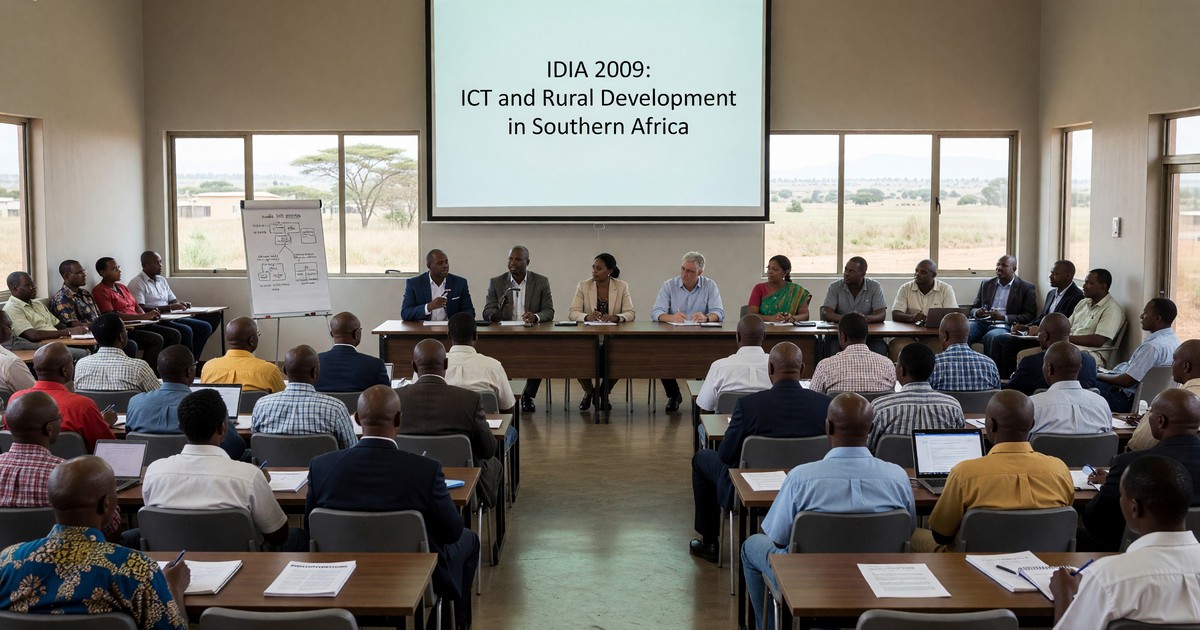
The 2009 International Development Informatics Association conference took place against a distinctive backdrop: the global financial crisis had begun to affect donor flows into ICT4D programs, while mobile phone adoption in southern Africa was growing faster than most analysts had predicted. The conference’s focus on rural development and ICT reflected a period when the field was genuinely uncertain whether the expanding mobile network would change the development calculus for rural communities, or whether the rural-urban digital divide would deepen despite growing coverage.
This overview covers the research themes, notable contributions, and debates that characterized the 2009 IDIA conference and its proceedings.
Context: The ICT4D Landscape in 2009
By 2009, the first wave of enthusiasm about telecentres and shared community computing was giving way to more cautious assessments. Field research from across southern Africa had documented the sustainability problems of the telecentre model — facilities that opened with donor funding and closed when the funding ended, often within two or three years.
At the same time, mobile phone adoption had surpassed expectations. By 2009, mobile penetration in South Africa exceeded 100 percent (meaning more SIM cards than people), and even in poorer neighboring countries like Zimbabwe, Lesotho, and Namibia, mobile penetration was growing rapidly. The feature phone — a basic mobile phone without smartphone capabilities — was becoming ubiquitous in ways that the PC never had been.
This created a productive tension at the 2009 conference: researchers who had spent years studying telecentres were confronting evidence that the model had largely failed, while researchers beginning to examine mobile phones were more optimistic but operating with a thinner evidence base.
Major Themes
Telecentre Sustainability and the Case for Pluralism
The dominant theme of the early conference sessions was telecentre sustainability — or rather, its absence. Papers from researchers who had conducted field studies across South Africa, Botswana, and Zimbabwe presented a consistent picture: telecentres that had been presented as successful in implementation reports were struggling to sustain usage, revenue, and organizational capacity in the medium term.
A significant methodological paper at the 2009 conference — later cited frequently in the ICT4D literature — examined the gap between project reporting (focused on outputs: centers opened, users trained, connections established) and the actual developmental outcomes over the following two to three years. The paper documented a pattern of what it called “implementation success, development failure” — programs that met all their initial output targets without producing sustained development benefit.
This observation contributed to the field’s methodological turn toward longer-term evaluation and more critical assessment of ICT4D claims.
Mobile Phones and Rural Livelihoods
A growing stream of papers at the 2009 conference examined mobile phone use in rural communities — departing from the telecentre focus to ask what ordinary rural residents were actually doing with the phones they owned.
This research found a diverse and often pragmatic set of uses: coordinating agricultural labor, checking market prices through informal networks (calling traders to ask prices before traveling to market), managing family remittances, coordinating cattle management across grazing areas, and maintaining social networks with urban family members.
Several papers in this stream were notable for their bottom-up methodology — rather than evaluating an implemented program, they began by asking rural residents what they were doing with technology and built their research questions from those observations. This inductive approach was relatively unusual at the time and has become more influential in subsequent ICT4D research.
Agricultural Information Services
A dedicated session on agricultural ICT drew on field research from across southern Africa — examining SMS-based price information services, voice-based advisory services (IVR systems providing agronomic advice), and the role of radio in agricultural information provision.
A recurrent finding: radio remained the dominant and most trusted information technology for rural farming communities in the 2009 period. ICT4D programs that sought to displace radio with mobile-based services often underestimated the depth of radio’s reach and trust.
The more successful ICT4D agricultural programs in this session were those that worked with radio rather than against it — using SMS to allow farmers to request follow-up information after radio broadcasts, or using mobile phones to allow farmers to call in questions to radio programs. This “mobile-radio integration” approach appeared consistently as a more promising design than mobile-only services.
Gender and Access in Rural Contexts
Research examining gender dimensions of rural ICT access was prominently represented at the 2009 conference, influenced by a growing body of feminist ICT4D scholarship.
Papers from field sites in rural South Africa, Lesotho, and Zimbabwe documented that while mobile phone ownership was growing rapidly, it was growing more rapidly among men than among women. Women’s access to phones was often mediated through husbands, fathers, or brothers — an important distinction from ownership, because mediated access typically involves monitoring of communications and restrictions on use.
The implications for ICT4D program design were debated in the session: if women’s access to mobile communication is controlled by male household members, what design choices can address this? Some researchers argued that shared community-based ICT programs (telecentres) were actually better for women’s access than individual device programs, because shared programs could be structured to create women-only access times and physical safety. Others argued that the telecentre model had failed for women for the same structural reasons it had failed generally.
Notable Contributions From the 2009 Proceedings
Several papers from the 2009 proceedings have been cited extensively in subsequent ICT4D scholarship:
“Beyond Access: What Rural South Africans Actually Do With Mobile Phones” — An ethnographic study of mobile phone practices in a rural Eastern Cape community, documenting that mobile phone use was deeply embedded in existing social and economic practices rather than transforming them. Frequently cited in discussions of technology adoption and domestication theory.
“Telecentre Sustainability: A Longitudinal Assessment of Ten South African Programs” — A systematic follow-up study of telecentre programs that had been documented as successful at implementation. The findings, which showed most had significantly reduced operations or closed by the study date, contributed to the field’s understanding of the implementation-development outcome gap.
“Radio-Mobile Integration in Agricultural Extension: Evidence From Zimbabwe” — A study of a program combining community radio with SMS interaction for agricultural extension services. One of the first empirical papers documenting positive outcomes from integrated radio-mobile agricultural information programs.
The 2009 Conference and the IDIA Research Community
By 2009, the IDIA community had developed a distinctive intellectual character — more willing than some ICT4D venues to publish critical and negative findings, more attentive to gender and power dimensions of ICT programs, and more centered on southern African researchers’ own analytical perspectives on their contexts.
The postgraduate workshop at the 2009 conference was notably productive, with several students who presented work in progress going on to publish significant ICT4D papers in subsequent years. The mentoring relationships formed through the IDIA network contributed to careers that shaped the field.
Frequently Asked Questions
What happened to telecentre programs in southern Africa after the 2009 conference? Most formal telecentre programs had wound down significantly by the early 2010s, as both donor interest and the development rationale shifted toward mobile-centered approaches. Some physical facilities were repurposed as multi-service community centers. A few persisted as government service delivery points. The concept of shared community ICT access re-emerged later in “digital hub” and “innovation hub” programs, though with different design philosophies.
Did the 2009 conference produce any policy influence? IDIA conference research influenced the thinking of some government officials and development practitioners who attended or read the proceedings, but the systematic research-to-policy translation pathway was weak, as it typically is in academic research. The conference’s influence was primarily on the research community rather than on implementing organizations.
How did the global financial crisis affect ICT4D research in 2009? Development budgets were pressured by the crisis, and some ICT4D program funding was cut or delayed. The impact on research specifically was mixed — some programs under evaluation were discontinued before researchers could collect planned follow-up data, while the crisis also created new research questions about ICT4D program resilience.
Were there papers from outside southern Africa at the 2009 conference? Yes — the conference attracted papers from researchers working in East Africa (Kenya, Tanzania), West Africa (Ghana, Nigeria), and Asia. International participation grew across the IDIA series, though the southern African core remained dominant.
What were the main methodological approaches at the 2009 conference? Case study and qualitative field research dominated, as in other IDIA years. The 2009 program had a notable emphasis on longitudinal and follow-up research — studying program outcomes over time rather than just at implementation. This reflected the field’s growing awareness of the gap between initial implementation outcomes and sustained developmental impact.
Further Reading from Authoritative Sources
- ICT4D Research Overview on Wikipedia — Wikipedia’s ICT4D article provides context for understanding the field’s development during the IDIA conference period.
- UNDP ICT for Development Policy — UNDP resources on ICT4D policy and programming, reflecting the policy context in which IDIA research was conducted.