Telecentre Programs in South Africa: Lessons From the Field
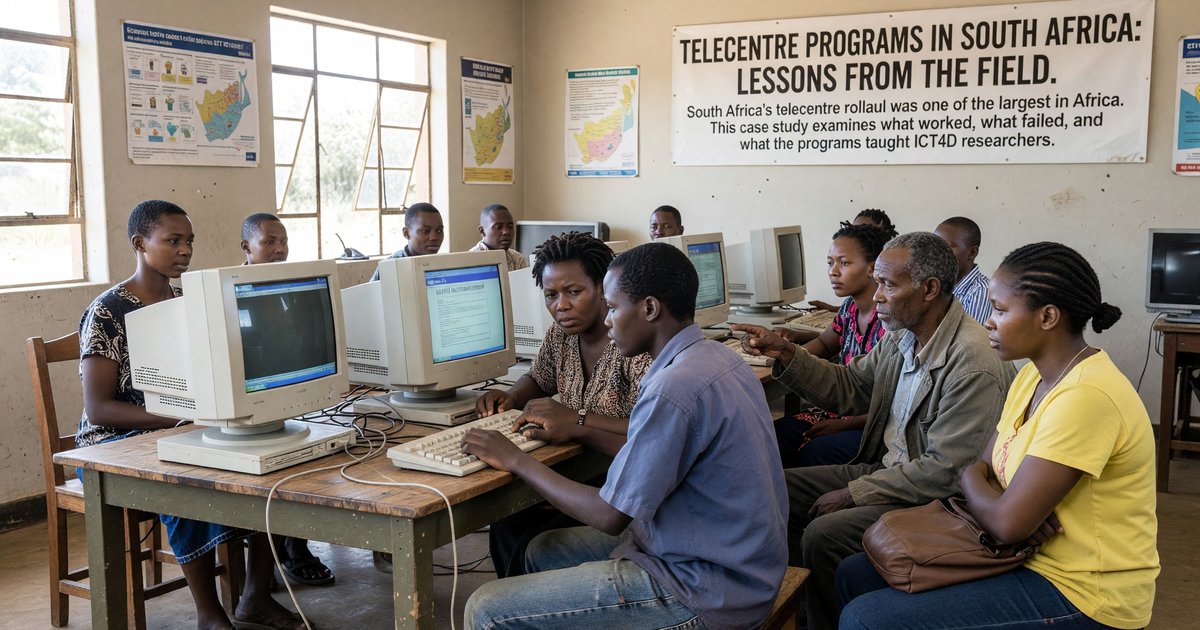
Between the late 1990s and early 2010s, South Africa ran one of the most ambitious telecentre programs in Africa. Funded by government, by multilateral development organizations, and by the country’s mandatory universal service obligations on telecommunications operators, the program sought to bring shared computer and internet access to communities that could not afford individual devices — primarily township residents and rural communities in the former homeland areas.
This case study examines the program’s design, its implementation challenges, its variable outcomes, and what researchers learned from it — lessons that shaped subsequent ICT4D thinking globally.
What Telecentres Were Supposed to Do
The telecentre model rested on a straightforward logic: in contexts where personal computers and home internet connections were unaffordable, shared community computing centers could provide access while spreading costs across many users. A single telecentre might provide email, internet, printing, government form assistance, and skills training to dozens of community members who could not individually bear the cost of connectivity.
This model was appealing to both development organizations (it addressed a real access gap) and governments (it could be funded through universal service obligations on telecoms operators, rather than from general budget). South Africa’s Universal Service and Access Agency (USAASA) became the primary government channel for telecentre rollout in the early 2000s.
The original vision was ambitious: thousands of telecentres spread across rural and peri-urban South Africa, providing the technical on-ramp for a newly democratic country’s citizens to participate in the digital economy.
Implementation: What Actually Happened
The gap between the telecentre vision and implementation reality was substantial. Researchers who conducted field studies across South African telecentres in the 2000s documented consistent patterns:
Low utilization: Many telecentres had equipment but few regular users. Usage rates were far below what financial sustainability required. In some facilities, computers sat largely idle for significant portions of the operating day.
Sustainability problems: The dominant funding model relied on government or NGO grants that covered initial capital costs (computers, furniture, connectivity) but not ongoing operating costs (salaries, rent, electricity, maintenance). When initial grants ran out, telecentres could not cover operating expenses through user fees — the fees necessary for sustainability were unaffordable for the target population, which was, by definition, low-income.
Location and logistics issues: Many telecentres were located in community halls, government buildings, or converted classrooms that were not always convenient to use, not always physically safe for women traveling alone, and not always in the communities with greatest need.
Staffing: Telecentres required skilled staff to manage operations, assist users, and maintain equipment. Finding, training, and retaining such staff in rural areas was a persistent challenge. Many facilities were understaffed or managed by undertrained volunteers.
Content irrelevance: Even in well-operated telecentres, researchers found that available online content — primarily in English, primarily oriented toward urban professional concerns — was not relevant to the interests and needs of many community members.
Cases That Worked — and Why
Not all South African telecentres failed. Several programs produced sustained community benefit, and examining what distinguished them is instructive.
Siyabonga Community Telecentre (KwaZulu-Natal): This program succeeded in part because of strong community ownership. The facility was managed by a local NGO with deep roots in the community, operated a community radio station alongside ICT services, and explicitly recruited women as primary users. The integration with radio — a medium the community already used and trusted — gave the telecentre a reason to exist beyond ICT access alone.
School-based programs: Several programs embedded telecentres within schools, which provided built-in users (students), built-in purposes (school work, teacher training), and an institutional home that could provide management continuity. School-based models showed better sustainability than standalone facilities when accompanied by curriculum integration.
Income-generating uses: Telecentres that developed specific income-generating services — printing, photocopying, government form completion assistance, identity document services — showed better financial sustainability. Adding services that users were willing to pay for (because they replaced a more expensive alternative, like travel to a city) improved the economic viability of the center.
What Researchers Learned: ICT4D Lessons
The South African telecentre experience contributed substantially to global ICT4D thinking on community ICT access. Key research findings:
Access without relevance is insufficient. The fundamental problem with many telecentres was that the internet they provided access to was not the internet these communities needed — it was an English-language, urban-professional, Northern Hemisphere internet that offered limited relevance to the information needs of Zulu-speaking rural households or Sotho-speaking township residents.
Sustainability requires a business model, not just a mission. Telecentres designed purely around development missions, without viable financial sustainability plans, predictably failed when grant funding ended. Organizations designing ICT access programs must model the ongoing costs and revenue streams from the beginning.
Community ownership matters more than technology. The most successful South African telecentres had strong community ownership — local organizations or community members who had real stakes in the facility’s success and genuine decision-making authority over its operations. Externally-imposed facilities without local ownership consistently showed lower sustainability.
Single-use facilities are fragile. Telecentres that existed only to provide internet access were vulnerable to any reduction in demand or support. Facilities that housed multiple services — radio, health information, government services, skills training — were more resilient because they served multiple needs and had more reasons to remain open.
Gender inclusion is active work. Research documented that women were significantly less likely than men to use most telecentres, due to a combination of factors: safety concerns about travel, social norms around women using public computing spaces, domestic time constraints, and content that was more relevant to male work and interests. Programs that actively recruited women — through women’s organizations, women-specific content, operating hours accommodating women’s domestic schedules — showed better gender equity in use.
The Post-Telecentre Era
By the mid-2010s, the telecentre model was widely recognized to have failed to meet its original ambitions. The spread of affordable smartphones — even if data remained expensive — fundamentally changed the ICT access landscape. Individual mobile devices provided private, portable connectivity that addressed several of the core problems with shared community facilities: inconvenience, relevance (users could access what they personally needed), and privacy.
This does not mean the telecentre era was worthless. The programs built skills in thousands of community members, produced substantial academic research that improved the field’s understanding of ICT access, and provided computing access to people who used it genuinely productively — even if not at the scale envisioned. And the policy lessons from telecentre failures shaped subsequent ICT4D programming toward more sustainable, community-owned, and locally-relevant models.
The shift from shared facilities to personal mobile devices also moved the ICT4D agenda: from “how do we get people access” to “how do people use the access they have, and how do we make that use more beneficial” — a more complex and more interesting research question.
Frequently Asked Questions
Are telecentres still operating in South Africa? Some community ICT access points persist in South Africa, often rebranded or integrated into multi-service community centers. The Thusong Service Centre program (which integrated government services with ICT access) has been more durable than standalone telecentres. But the classic 2000s-era telecentre model is largely defunct.
Was the South African telecentre experience representative of Africa as a whole? South Africa’s telecentre program was distinctive in its scale and in the country’s specific income distribution (high inequality, relatively high formal economy participation). Other African countries ran similar programs with broadly similar results — particularly on sustainability challenges. The lessons generalize fairly well across the African telecentre literature.
Did the government learn from telecentre failures? Partially. Subsequent South African government ICT access programs have shown more attention to operating cost sustainability and have shifted emphasis toward mobile connectivity (school broadband programs) rather than shared computing facilities. The policy learning was incomplete and slow, as is often the case with government program evaluation.
What happened to the ICT4D researchers who studied South African telecentres? Many went on to careers in academic ICT4D research, informing subsequent programs internationally. The research community around South African telecentres contributed significantly to the global ICT4D literature — particularly through the Meraka Institute at CSIR and through academics at the University of the Western Cape and other South African universities who published extensively on their findings.
Is there a connection between the telecentre research and the IDIA conference? Yes — significant overlap. Many of the researchers who attended IDIA conferences had conducted field research on South African telecentres. The telecentre case study was a major empirical touchstone for the ICT4D discussions at early IDIA conferences, which were held during the period when the telecentre era’s failures were becoming apparent.
Further Reading from Authoritative Sources
- UNESCO Community Media and ICT Access — Wikipedia’s telecentre overview covers the global telecentre movement, including South African programs, in historical context.
- UNDP ICT for Development Country Programs — UNDP’s digital development resources cover community ICT access programs across Africa, including lessons learned from first-generation programs.