M-Pesa in Kenya: The ICT4D Case Study That Changed Everything
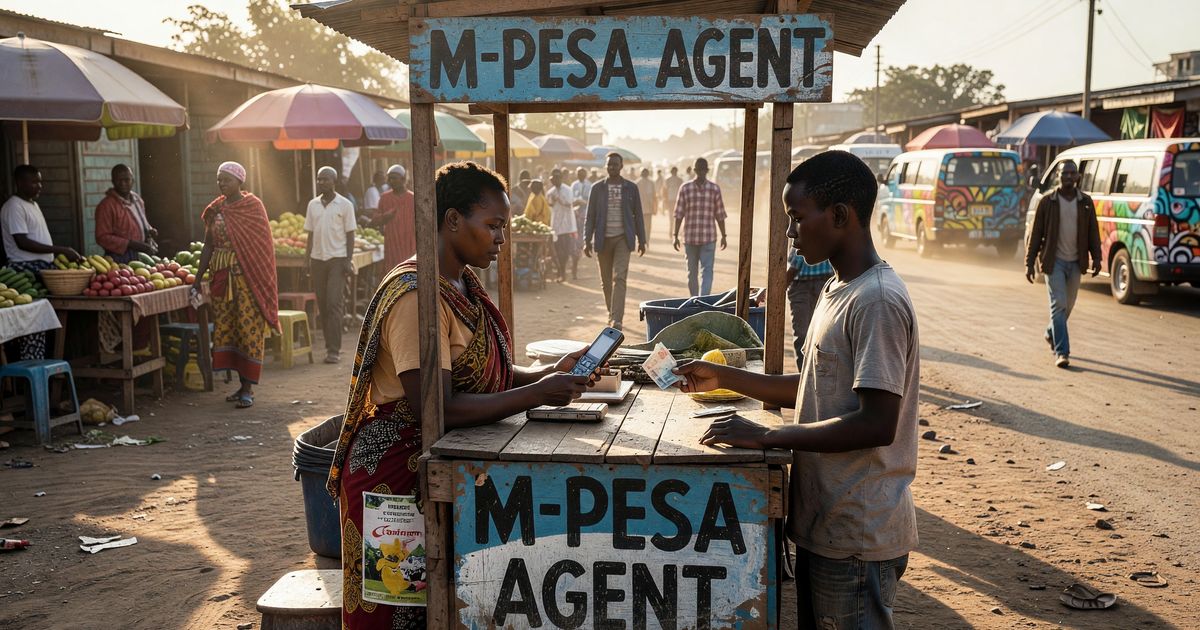
When Safaricom launched M-Pesa in Kenya in March 2007, the service was conceived as a simple tool to help microfinance clients make loan repayments by mobile phone. Within a year, it had outgrown that original use case so completely that the designers had to rethink what they had built. Within three years, it was Kenya’s dominant domestic money transfer system. Within a decade, it had become the most studied example of technology-enabled financial inclusion in the world.
This case study examines M-Pesa’s origins, its growth trajectory, the evidence base on its development impact, and the harder lessons about what made it work and why it has proved difficult to replicate exactly.
Origins and Early Design
M-Pesa was designed as a collaborative project between Safaricom (Vodafone’s Kenyan subsidiary) and the UK’s DFID (Department for International Development). The initial concept was modest: allow microfinance customers to make loan repayments through their mobile phones rather than physically traveling to a branch office. This addressed a real friction — microfinance branches in Kenya were often hours away from rural borrowers, and the cost of travel for repayment was a significant burden.
DFID funded a pilot in 2005 and 2006 that tested the basic transfer mechanism. The pilot results showed that customers were using the system in ways the designers had not anticipated — not just for loan repayments, but for general person-to-person transfers, particularly sending money between urban workers and rural family members.
This discovery reshaped the service’s design before public launch. The commercial launch in March 2007 positioned M-Pesa as a general money transfer service, with the tagline “Send money home.” The framing was deliberately about the most fundamental use case: urban-to-rural domestic remittances.
The Growth Trajectory
M-Pesa’s adoption growth curve was exceptional by any standard:
- March 2007: Launch. Initial registered users in the tens of thousands.
- End of 2007: 2.7 million registered users
- End of 2008: 6.5 million registered users; transaction volumes exceeding KES 100 billion annualized
- End of 2009: 9.5 million users; agent network of over 17,000 agents
- End of 2011: 14 million users; M-Pesa handling more transactions than the entire banking system
Several factors drove this growth:
Agent network economics: Safaricom recruited and trained a nationwide agent network — small shopkeepers, pharmacists, petrol stations — who earned commissions on cash-in and cash-out transactions. This created a self-sustaining network incentive: agents wanted to recruit new users (more transactions, more commission) and users wanted more agents (more places to cash out). The network effect accelerated adoption.
Regulatory environment: Kenya’s Central Bank initially took a permissive approach — licensing M-Pesa as a payment service while formal banking regulation developed. This window allowed the service to scale before regulatory constraints were designed around the traditional banking model.
High baseline need: Kenya in 2007 had low formal banking penetration (around 20 percent of adults) but high need for domestic remittances. The urban-to-rural transfer market was served primarily by informal channels (physically carrying cash on buses) that were unreliable and risky. M-Pesa addressed a real, urgent need.
Trust in Safaricom: Safaricom was already the dominant mobile operator in Kenya with high brand recognition. Consumer trust in the operator transferred to trust in the new financial service.
The Evidence Base on Development Impact
The most influential evaluation of M-Pesa’s development impact is Suri and Jack (2016), published in the journal Science. Using the rollout timing of M-Pesa’s agent network as a source of quasi-random variation in access, they estimated:
- 2 percent average increase in per-capita consumption for households that gained M-Pesa access
- 22 percent increase in consumption for households headed by women at the bottom of the income distribution who gained access
The mechanisms they identified: consumption smoothing through informal transfers during income shocks (illness, crop failure), savings accumulation enabled by the mobile savings service M-Shwari (a later product), and economic diversification as reliable payment infrastructure enabled entry into small-scale trade.
Subsequent research has added nuance:
Jack and Suri (2011) documented that M-Pesa users were substantially better able to smooth consumption in response to negative shocks — illness events, in particular — because they could receive remittances from family networks more quickly and at lower cost than non-users.
Research on women’s empowerment has found that women who gained independent access to mobile money (rather than access mediated through a husband or male household member) showed measurable improvements in savings rates, entrepreneurship, and reported financial autonomy.
Tavneet Suri and colleagues have also documented that M-Pesa adoption was faster among users in the middle of the income distribution than among the poorest — the agent network economically required that transactions be large enough to cover agent commission costs, creating practical minimums that excluded the very poorest.
What Made M-Pesa Work: A Framework
Researchers have spent years trying to distill what conditions enabled M-Pesa’s success. The most commonly cited factors are:
Large unmet need: The baseline financial exclusion in Kenya was high, and the alternatives to M-Pesa (bus cash transport, informal hawala networks) were demonstrably worse.
Regulatory permissiveness at the right moment: The window before formal regulation allowed the service to scale and prove itself before rules designed for a different context could constrain it.
Agent economics: The commission structure created sustainable incentives for agents to join and stay active, producing a distribution network that the service could not have funded directly.
Operator trust: Starting with a trusted mobile operator meant the financial service inherited an existing trust relationship with consumers.
Simple, reliable user experience: Early M-Pesa was a narrow service — send money, receive money, cash in, cash out — that worked consistently on basic handsets via USSD (a text-based protocol that worked on 2G networks). Simplicity enabled adoption across literacy and income levels.
Active use case development: Safaricom actively recruited use cases — utility bill payment, salary disbursement, government payment, retail payment — that made M-Pesa useful beyond the original remittance case. Each new use case added value for existing users and gave new users reasons to join.
Lessons for ICT4D Practitioners
Lesson 1: Design for the existing use, then expand. M-Pesa succeeded partly because it started with one clear, urgent use case (remittances) and did it very well before expanding. ICT4D projects that try to serve many use cases simultaneously often serve none well.
Lesson 2: The distribution layer may be more important than the technology. The agent network was as central to M-Pesa’s success as the mobile technology itself. ICT4D interventions that ignore the “last mile” distribution problem often fail to reach intended users.
Lesson 3: Context is not transferable. Vodafone attempted to replicate M-Pesa in South Africa, India, Tanzania, Romania, and other markets. Results were inconsistent. Kenya’s specific combination of banking exclusion, regulatory environment, operator strength, and use case fit did not exist elsewhere in identical form.
Lesson 4: Gender is embedded in adoption, not added on. The most significant welfare effects in the research literature were found for women — but women also adopted more slowly and through more complex pathways. Designing for gender inclusion requires attention to household dynamics, social norms, and differential access barriers from the outset.
Frequently Asked Questions
Is M-Pesa still active? Yes. M-Pesa continues to operate in Kenya and several other countries, and has expanded its services significantly beyond the original transfer model to include savings, credit (M-Shwari), investment products, and merchant payment systems. It remains dominant in the Kenyan mobile financial services market.
Has M-Pesa actually reduced poverty in Kenya? The research evidence (particularly Suri and Jack 2016) documents measurable household consumption gains for M-Pesa users, particularly women. Whether this constitutes “poverty reduction” at scale is a more complex question — the gains were real but modest for average users, with larger gains concentrated in specific subgroups.
Why did M-Pesa work in Kenya but struggle in South Africa? Several factors: South Africa had much higher formal banking penetration (around 60 percent at M-Pesa’s launch there), meaning the addressable unbanked market was smaller. South African banking regulators required M-Pesa to operate under banking regulations from the start, raising compliance costs. And South Africa had a more competitive mobile market with lower operator trust concentration.
What is the connection between M-Pesa and mobile credit? M-Shwari, launched in 2012 as a partnership between Safaricom and Commercial Bank of Africa, added credit and savings products linked to M-Pesa accounts. Credit eligibility was determined by M-Pesa transaction history — one of the first large-scale examples of using mobile transaction data for credit scoring in a low-income context.
Who owns M-Pesa? M-Pesa was operated by Safaricom in Kenya. Vodafone and Vodacom had rights to operate M-Pesa in other markets. In 2020, Safaricom and Vodacom acquired the M-Pesa brand and intellectual property from Vodafone.
Further Reading from Authoritative Sources
- World Bank Overview: Financial Inclusion and Mobile Money — The World Bank’s financial inclusion resources cover the global context for mobile money programs, including M-Pesa’s role in the research evidence base.
- GSMA Mobile Money Report — The GSMA’s annual mobile money industry data, covering adoption, transaction volumes, and market development across low- and middle-income countries.