Community Radio and ICT Integration in Sub-Saharan Africa
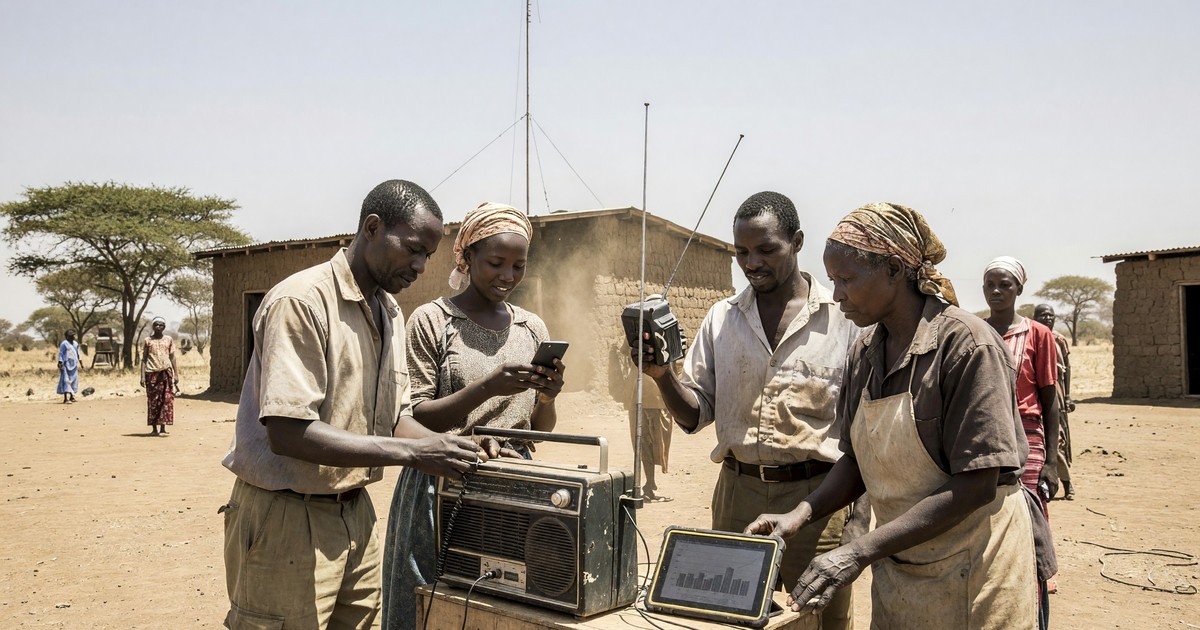
Before mobile phones, before the internet, before telecentres — before most of the ICT4D programs that have drawn billions of development dollars — there was community radio. In sub-Saharan Africa, community radio stations have been providing information, education, cultural programming, and local voice to rural communities since the 1960s. In the ICT4D field’s obsession with digital novelty, radio’s fundamental importance and its integration with newer technologies has often been underappreciated.
This case study examines community radio’s role in African ICT4D programming, the emergence of radio-mobile integration approaches, and what the experience of radio in development tells us about appropriate technology and sustainable information access.
Radio as Appropriate Technology
The concept of “appropriate technology” — technology that fits the resources, constraints, and capabilities of the communities using it — was articulated in development discourse before ICT4D existed as a field. In the information domain, radio has been the most consistently appropriate mass communication technology for rural Africa:
Penetration: Community radio reaches populations that have no internet, no mobile internet, and often unreliable mobile phone coverage. FM signals carry further than mobile networks, and battery-powered radios operate without grid electricity.
Language: Community radio broadcasts in local languages — Bambara in Mali, Kirundi in Burundi, dozens of languages across Ethiopia. Unlike most internet content (in English, French, or standard national languages), radio speaks to people in the language they actually use.
Literacy independence: Radio is purely oral — it does not require literacy to use. This is a fundamental advantage in contexts where adult literacy rates are below 50 percent in many rural areas.
Social use: Radio listening is often communal — family members, neighbors, and community groups gather to listen together, then discuss what they heard. This social dimension amplifies individual reach and enables collective sense-making of broadcast content.
Low cost: The cost of a battery-powered radio receiver is within reach of most rural households across Africa — far below the cost of a smartphone, and with no ongoing data cost.
Community Radio in Development Programming
Community radio has been used in development programs across sub-Saharan Africa for health communication, agricultural extension, literacy promotion, civic education, and emergency response:
Agricultural extension: Organizations including Farm Radio International, Panos Africa, and numerous national agricultural extension services have used radio to deliver agronomic information — planting timing, pest management, weather forecasts, market price information — to farmers at scale. Radio agricultural programs have reached millions of farmers who would never encounter a government extension agent.
Health communication: The HIV/AIDS epidemic in sub-Saharan Africa in the 1990s and 2000s saw massive investment in radio health communication — behavior change messaging, treatment literacy, stigma reduction programming. Evidence from several countries suggests radio health campaigns reached populations who would not access clinic-based information.
Civic education and elections: Community radio has been used extensively for voter education, civic information, and post-election monitoring in African countries. The role of radio in Rwanda’s 1994 genocide — where Radio Mille Collines broadcast incitement — has made the sector acutely aware of radio’s power for harm as well as good.
Radio-Mobile Integration: The Emerging Paradigm
By the late 2000s, ICT4D practitioners in Africa were recognizing that radio and mobile phones — separately, each highly valuable — were even more powerful in combination. Several integration approaches emerged:
Interactive Radio via SMS
Programs that combined radio broadcasts with SMS-based interaction allowed radio audiences to participate, ask questions, and respond to content. In agricultural programs, farmers could send SMS questions to radio show hosts, who would respond on air or through returned SMS. In health programs, radio quizzes with SMS response mechanisms assessed and reinforced health knowledge.
This approach leveraged radio’s mass reach while using SMS’s interactivity to shift from one-way broadcast to two-way communication — without requiring smartphone-level connectivity. The combination worked well in contexts where mobile voice and text coverage was available even when mobile data was not.
SMS for Radio Program Feedback and Audience Research
Radio stations in many African countries have used SMS short codes to collect audience feedback — topic suggestions, listener questions, and program evaluations. This gave radio stations data about their audiences that was previously only available through expensive surveys, enabling more responsive programming.
Voice-Based Information Services (IVR)
Interactive Voice Response systems — telephone-based automated services navigated through voice or keypad — extend radio-style oral information to on-demand access. Farmers can call an IVR service to hear current market prices, weather forecasts, or agronomic advice in their local language, at a time of their choosing rather than when the radio program is scheduled.
IVR services have been deployed by agricultural programs in Ghana, Tanzania, Uganda, Ethiopia, and several other countries. Research comparing IVR to SMS services consistently finds higher adoption among the less educated and less literate, because IVR requires no reading.
Mobile-Enabled Radio Content Contribution
Programs have enabled rural community members to contribute voice recordings to community radio stations via mobile phone — creating a more representative radio voice for underserved communities. This “mobile journalism” approach has been documented in Kenya, Uganda, and several West African countries.
Farm Radio International: A Case in Community Radio ICT4D
Farm Radio International (FRI), a Canadian non-profit, has operated agricultural radio programs across sub-Saharan Africa for over 40 years. Its experience offers the longest longitudinal view of radio-based agricultural communication in the development sector.
FRI’s programming model has evolved significantly over four decades:
Original model (1970s–1990s): Broadcast-based scripted programs developed by FRI and adapted for local broadcast. One-way information delivery; no feedback mechanism.
Interactive radio (2000s): Integration of listener feedback via postal mail, then SMS. Programs began receiving and responding to farmer questions. Research showed that interactive format increased engagement and information retention compared to pure broadcast.
Digital integration (2010s): FRI developed Farmbook, a digital database of agricultural production practices linked to radio programming, allowing radio programs to reference specific advice sheets accessible online. For literate farmers with internet access, radio programs pointed toward deeper resources; for the majority, the radio itself remained the primary medium.
Platform integration (2020s): FRI now integrates radio with mobile app platforms, IVR services, and social media — while maintaining community radio as the core mass-reach medium.
FRI’s evolution illustrates a principle that ICT4D researchers have articulated theoretically: the most effective programs use a portfolio of media rather than a single channel, matching medium to function. Radio for mass reach and trusted voice; SMS or IVR for interaction and personalization; print materials for reference information; community gatherings for collective action.
Lessons for ICT4D Design
Build on existing information practices, don’t replace them. Community radio is already trusted, already integrated into community life, already speaking local languages. ICT4D programs that harness this existing infrastructure outperform programs that try to build new information infrastructure from scratch.
Oral technology is not inferior to text technology. The field’s bias toward text-based digital platforms reflects the educational and cultural context of program designers, not the needs of the communities being served. In low-literacy contexts, voice-based and oral media are more appropriate, not less sophisticated.
Sustainability through existing institutions. Community radio stations — especially those operating under community ownership models with broadcast licenses — have the institutional longevity that individual ICT4D project implementations typically lack. Partnering with radio stations provides sustainability by piggybacking on an existing institutional foundation.
Appropriate technology is context-determined. In some communities, in some contexts, for some purposes, a text-based mobile app is the right tool. In many rural African contexts, community radio remains more appropriate — and the most effective ICT4D programs integrate both rather than choosing one.
Frequently Asked Questions
Is radio use declining in Africa because of smartphone adoption? Radio use is shifting rather than simply declining. Smartphone adoption is concentrated in urban areas and among younger, more educated populations. Rural and older populations continue to rely heavily on radio. Radio’s total audience in sub-Saharan Africa has not declined significantly, though listening habits have changed — more listening through mobile phone speakers and digital radio platforms alongside traditional FM radio.
Who funds community radio in Africa? Community radio funding is diverse: community subscription models, local advertising (particularly from agricultural input companies and NGOs running campaigns), government support in some countries, and international NGO project funding. Sustainability of community radio is a persistent challenge, particularly in communities too small to generate significant advertising revenue.
What is Farm Radio International’s geographic reach? Farm Radio International operates programs in approximately 25 African countries, working with over 500 radio stations and reaching an estimated 25 million farmers through its radio network.
Can community radio improve disaster response? Yes — community radio is widely recognized as a critical disaster risk reduction communication tool. Its ability to broadcast during power outages (battery-powered transmitters), its local language reach, and its existing listener trust make it more effective for disaster communication than many digital channels. UNESCO and UNDP have both documented community radio’s disaster communication role in Africa and Asia.
What happened to many ICT4D programs that ignored radio? Programs that built parallel digital information infrastructure without integrating radio frequently faced adoption challenges — particularly among older, less educated, and more rural populations who were already reached effectively by radio but not by digital platforms. Several large-scale agricultural ICT programs have been redesigned to integrate radio after initial adoption targets were not met.
Further Reading from Authoritative Sources
- UNESCO Community Radio and Development — Wikipedia’s community radio overview covers the global community radio sector, including sub-Saharan African programs and their development role.
- GSMA Mobile for Agriculture — GSMA research on mobile internet in agricultural contexts, covering the intersection of mobile and other communication media in development programs.