Agricultural ICT in India: From e-Choupal to Today's Digital Farmer
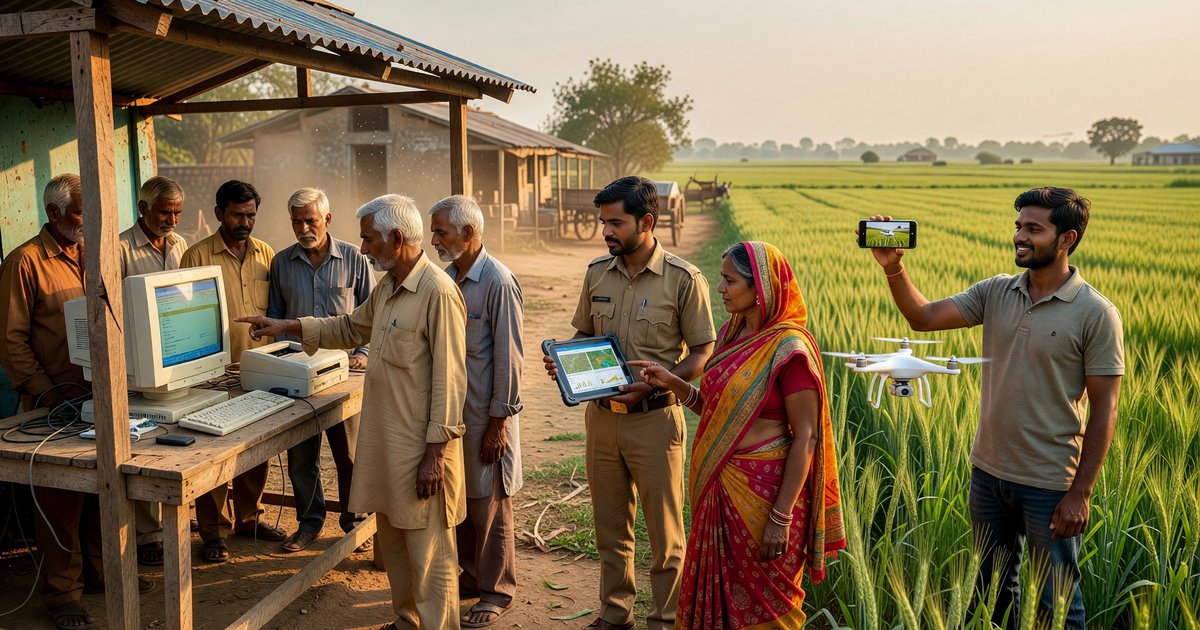
India’s agricultural sector — employing hundreds of millions of smallholder farmers across a continent-sized country with dramatic variation in crop systems, geography, language, and infrastructure — has been a major site of ICT4D experimentation since the early 2000s. The country’s combination of high agricultural employment, significant information asymmetries in commodity markets, and diverse governance structures at state and district level has made it an almost ideal natural laboratory for testing whether information technology can improve smallholder farmer outcomes.
This case study traces the major agricultural ICT programs in India from the landmark e-Choupal project through subsequent government and private sector initiatives, drawing on a research literature that spans two decades.
e-Choupal: The Foundational Case
ITC Limited, one of India’s largest agribusiness conglomerates, launched e-Choupal in 2000. The program placed internet-connected kiosks in rural villages of Madhya Pradesh (focused on soybean) and subsequently expanded to other states and crops. The kiosks — operated by a local farmer designated as a sanchalak (facilitator) — provided:
- Market price information: Daily prices for the local mandi (agricultural market) and for ITC’s own buying price, which was typically set at or above the mandi price
- Weather information: Local weather forecasts relevant to farming decisions
- Agricultural best practices: Crop management information, pest identification, and input guidance
- Transactional access: The ability to sell directly to ITC, bypassing the mandi intermediary chain
By 2010, e-Choupal had established over 6,500 kiosks covering approximately 40,000 villages and 4 million farmers.
The program has been extensively studied and debated in the ICT4D literature. The most commonly cited findings:
Positive: Farmers who sold to ITC through e-Choupal received systematically higher prices for their crop — studies found price premiums of 5–10 percent over mandi prices. The transparency of pricing information also appeared to improve bargaining outcomes in the mandi itself — farmers who knew the price before going to market were less subject to manipulation by traders.
Critical: e-Choupal served ITC’s procurement interests as much as (or more than) farmers’ interests. The program improved ITC’s supply chain efficiency and reduced its procurement costs. Whether the benefits to farmers outweighed ITC’s extraction of value is a complex calculation that depends on counterfactual assumptions. Some researchers argued that the program primarily transferred value from traders to ITC, with a secondary share going to farmers.
Methodological: The absence of a rigorous evaluation (randomized or otherwise) with a credible control group means that causal attribution of farmer income gains to e-Choupal specifically is uncertain. Farmers who chose to sell through the program differ systematically from those who did not.
Government Programs: AGMARKNET and eNAM
India’s government has run parallel agricultural ICT programs at the national and state level, with variable results.
AGMARKNET: Launched in 2000 by the Directorate of Marketing and Inspection (DMI), AGMARKNET created an online database of commodity prices from mandis across India. The network currently covers over 3,500 markets. Research has found that AGMARKNET price information, where it reaches farmers, is associated with reduced price dispersion across markets — consistent with better market integration.
eNAM (National Agriculture Market): Launched in 2016, eNAM is a more ambitious project: a pan-India online trading platform enabling electronic trading of agricultural commodities across mandi networks. The vision is a unified national market for agricultural commodities, with price discovery through competitive bidding.
As of 2024, eNAM has connected over 1,000 markets and facilitated billions of dollars in trade. However, research and policy evaluations have documented significant implementation challenges: actual electronic trading volumes are a fraction of potential; resistance from established mandi traders who benefit from existing opacity; connectivity and device constraints in many mandis; and quality assay (the grading and verification of commodity quality required for anonymous electronic trading) not yet standardized.
The eNAM experience illustrates a recurring pattern in agricultural ICT: the technical platform is buildable, but the market institutions and social practices that electronic trading assumes do not automatically adapt.
Private Sector Digital Agriculture Platforms
The past decade has seen explosive growth of private agricultural technology platforms in India — from crop-specific advisory services to satellite-based crop monitoring to artificial intelligence-driven input recommendation. These platforms represent a new generation beyond the first-wave e-Choupal model.
Crop advisory services: Platforms including Fasal, Cropin, Gramophone, and many others provide personalized crop management advice to registered farmers — pest and disease alerts, irrigation recommendations, market timing guidance. These services use combinations of satellite imagery, weather data, local field data, and agronomic expertise.
Market linkage platforms: Platforms including DeHaat, AgriBazaar, and Ninjacart operate digital supply chains connecting smallholder farmers with wholesale buyers, institutional purchasers, and occasionally retailers, reducing intermediary costs and providing price transparency.
Credit and insurance: Digital platforms integrated with satellite crop data and farmer profiles are enabling new forms of agricultural credit (linked to crop cycle and predicted yields) and index insurance (payouts triggered by weather data rather than individual farm loss assessments).
ICT4D researchers are beginning to study these new platforms rigorously, but the evidence base is thin relative to the investment scale. Early findings suggest that adoption of digital platforms is concentrated among larger, more commercially oriented farmers — the smallest and most resource-constrained farmers are least likely to be reached.
What Indian Agricultural ICT Research Has Established
The two-decade literature on agricultural ICT in India has established several reasonably robust findings:
Price information reduces information asymmetry. Farmers who have access to current market price information — whether through e-Choupal, AGMARKNET, or mobile price alerts — receive higher prices for their crops. The effect is documented across multiple studies and contexts. The mechanism is straightforward: informed sellers are harder to cheat.
Information is necessary but not sufficient. Price information helps farmers sell at better prices; it does not help them produce more, manage risk better, or access credit and insurance. More comprehensive agricultural information services (combining market, agronomic, weather, and financial information) potentially address a wider range of constraints, but are harder to design and sustain.
Market integration requires more than connectivity. The eNAM experience illustrates that creating a digital trading platform does not automatically create a functioning electronic market. Physical infrastructure (grading equipment, storage, logistics), regulatory frameworks (who can trade, under what conditions), and trust between unknown counterparties across a national market are all required.
Private sector models face sustainability challenges at the bottom of the income distribution. The most commercially viable agricultural ICT services tend to reach larger, more commercially oriented farmers first. Reaching the smallest and most marginal farmers — those with the greatest need — requires either cross-subsidy models, public sector support, or radically lower-cost service models.
Frequently Asked Questions
Has agricultural ICT increased farmer incomes in India? The most rigorous studies on specific programs (e-Choupal, market information services) find modest positive effects on prices received — not overall income, which depends on many non-ICT factors. The distribution of benefits has been uneven, with better-positioned farmers gaining more.
What is the role of the smartphone in agricultural ICT in India? Smartphone penetration among Indian farmers has grown rapidly, reaching over 50 percent of farming households by the early 2020s. This has shifted the platform from shared village kiosks (the e-Choupal model) to individual device-based services. The shift has also moved the primary access point from a facilitated, mediated experience to an individual, unmediated one — which changes both adoption patterns and the types of services that work.
How does climate change interact with agricultural ICT? Climate variability is increasing the value of real-time agronomic and weather information for Indian farmers. Platforms combining satellite climate data with crop-specific advice have shown early promise in helping farmers adapt management decisions (irrigation timing, pest pressure management) to variable weather. This is an area of active research and investment.
What has the Indian government’s role been in agricultural ICT? The Indian government has been simultaneously a platform builder (AGMARKNET, eNAM), a data source (satellite and weather data infrastructure), a regulator (agricultural markets are state-regulated, creating a patchwork of rules), and a funder of private sector development. The interactions between government programs and private platforms are complex and have not been fully analyzed.
Are there parallels between India’s agricultural ICT experience and African programs? Yes — significant parallels in what works (price information) and what is harder (market integration, smallholder reach). African agricultural ICT programs have often explicitly referenced the Indian experience, though contextual differences (land tenure, crop systems, market structure) limit direct transferability.
Further Reading from Authoritative Sources
- World Bank Agriculture and ICT — World Bank digital agriculture resources cover the evidence base on agricultural ICT programs across South Asia and Africa.
- OECD Agricultural Markets and Digital Tools — OECD analysis of how digital tools are reshaping agricultural markets, including coverage of developing country programs.